
In August 2026, the median sold price in NVAR’s core Northern Virginia market was $765,000, according to NVAR.
At that price, the equity in your current home and the cash for your next one are both big numbers. When you are selling and buying home at same time Northern Virginia, timing decides three things. It decides how much equity you protect, whether your kids start the school year in the right place, and whether you have a place to live on moving day.
I have worked in Northern Virginia real estate for 24+ years and 2,000+ transactions, including many overlapping sales and purchases. In my experience, the families who do this well pick a sequence on purpose. Then they write that sequence into both contracts.
You are running two deals at once: the sale of your current home and the purchase of your next one. This guide covers the three sequences and the lending rules that decide which one you qualify for. It also covers the contract terms that tie both deals together, and how settlement money actually moves in Virginia. If you are downsizing, there is a section for you too.
Selling and buying home at same time Northern Virginia: which sequence fits?
Pick the sequence your cash and your loan approval can support. Sell first if you need your equity for the down payment. Buy first if you can qualify with both housing payments and cover cash to close without the sale. Make a contingent purchase if you need the sale money but want to lock in the next home now.
Three questions sort most families quickly:
- Cash. How much can you bring to closing without selling?
- Qualification. Will a lender approve you with both housing payments counted?
- Housing tolerance. How many weeks could you live in a rental, with family, or in a rent-back?
Here is how the three sequences compare on the four points that matter most.
| What you are weighing | Sell first | Buy first | Contingent purchase |
|---|---|---|---|
| Down-payment access | Sale proceeds are in hand before you buy. | You need savings, a bridge loan, or other funds to close. | Sale proceeds fund the purchase if both settlements hold. |
| Overlapping payments | None, or a short gap. | Likely, until the old home sells. | Usually short, if the settlements are close together. |
| Moving twice | Likely, unless you negotiate a rent-back. | Rarely. | Rarely, if the dates hold. |
| Contractual protection | Your purchase does not depend on a sale. | No sale protection. You may own two homes for a while. | A home-sale or home-close contingency lets you exit on the terms you negotiated. |
Those last two terms sound alike. They protect you in different ways. A home-sale contingency gives you time to sell your current home before you close on the new one. A home-close contingency is narrower. It applies when you already have a buyer under contract and need time for that sale to settle (NAR, 2025). Northern Virginia forms call the second version a settlement contingency.
Lenders care about the difference too. A signed sale contract with your buyer’s financing contingencies cleared can let a conventional lender leave your old payment out of your ratios (Fannie Mae Selling Guide, 2026). More on that below.
Illustrative case: a Vienna move-up family racing the school calendar
Illustrative example. The family is hypothetical, and all numbers are rounded.
Picture a family in a Vienna townhouse worth about $750,000, with $400,000 left on the mortgage. They want a detached home in Fairfax near $1,100,000. They want to be moved in before the school year starts.
Their paper equity is about $350,000. They cannot spend it until the townhouse settles. Their savings cover moving costs and some closing costs. A 20% down payment stays out of reach until the sale closes. That is the classic move up buyer Northern Virginia problem: the money is real, but it is locked in the house.
- Buy first. Their lender counts both mortgage payments. On paper, the ratios do not work.
- Contingent purchase. They find the Fairfax home in May and offer with a home-sale contingency. The seller accepts but adds a kick-out clause, and the townhouse must go active in the MLS within the agreed number of days.
- Sell first. They list the townhouse in April, ratify in May, and negotiate a short rent-back so they can stay while they shop.
Their fallback matters as much as the plan. If the right Fairfax home has not appeared by the townhouse settlement, they sign a short-term rental near their current school. The school routine holds while the search continues. This is the core trade-off in selling and buying home at same time Northern Virginia: certainty about housing on one side, certainty about money on the other.
Can home equity fund the next purchase before selling?
Only after you turn it into cash. Equity on paper does not count as cash to close. You unlock it by selling, by borrowing against it, or by using other savings.
Paper equity is your home’s value minus your mortgage balance. Cash to close is what the settlement agent needs on purchase day: down payment, closing costs, and prepaid items. Your lender will want to see where every dollar comes from. Your equity also shrinks by your selling costs before it reaches you. Here is a breakdown of the cost to sell a home in Northern Virginia.
The lending rules decide the rest. Say your current home is under contract but will not close before your new purchase. A lender following Fannie Mae’s rules generally must count both housing payments. The exception requires two documents: the executed sale contract for your current home, and confirmation that any financing contingencies have been cleared (Fannie Mae B3-6-06, 2026).
Bridge loan vs sell first: the Northern Virginia math
A bridge loan lets you borrow against your current home to close on the next one. Fannie Mae accepts bridge loan funds for closing on a new principal residence. The bridge loan cannot be secured against the new property (Fannie Mae B3-4.3-14).
The debt still counts. Your lender has to show you can carry both homes, the bridge loan, and your other debts. Ask your lender how it counts the bridge payment (Fannie Mae B3-6-05, 2026). The executed-contract exception above can remove your current home’s payment from the math.
The bridge loan vs sell first Northern Virginia choice comes down to three numbers:
- Carrying cost. Both mortgage payments plus the bridge payment, times the months your old home could take to sell.
- Bridge cost. The loan’s fees and rate, which you pay even if your home sells fast.
- Sell-first cost. A rent-back, a short-term rental, storage, and a second move.
Run both columns before you list. Many conventional loans follow Fannie Mae’s rules. FHA, VA, jumbo, and portfolio lenders can set their own, so ask your lender for their policy in writing.

Which contract protections connect the transactions?
Negotiate each protection separately. Your sale contract, your purchase contract, and any sale or settlement contingency are separate promises. On your sale, a replacement-home contingency can let you cancel if you have not ratified a contract on your next home by a set date. A financing contingency covers your loan approval only. If your buyer backs out, you need a separate sale or settlement contingency.
In Northern Virginia, these terms usually sit in an NVAR contingency addendum. Since July 1, 2026, that addendum requires a buyer’s home to be listed in Active status in the MLS within a negotiated number of days after ratification (NVAR, 2026).
Use this checklist before you write an offer. Each item is a term you negotiate when selling and buying home at same time Northern Virginia.
- Deadlines. Write down every date: when your home must go active, when it must be under contract, and when it must settle. Match each one to a date in your purchase contract.
- Kick-out notice. A kick-out clause lets the seller keep marketing their home. If they get another offer, you get notice to remove your contingency or step aside. You may hear 72 hours quoted as standard. In the NVAR form, the notice period is a number of days you and the seller fill in. Know yours before you sign.
- Evidence to remove a contingency. Agree in advance on what proof counts: a ratified contract on your home, your buyer’s loan commitment, or written confirmation that their financing contingency is cleared. Your own lender may ask for the same papers.
- Delayed-closing remedies. A settlement contingency can cap how many days your purchase may be delayed if your sale slips. Agree up front on extensions, who pays added costs like a rate-lock extension, and what happens to the deposit if the cap is reached.
Read both contracts side by side. The dates should read like one schedule.
How should closing, proceeds, and possession line up?
Treat them as three separate milestones. You sign at settlement. Your sale money generally arrives after the deed is recorded. Possession moves on the date your contract sets. Build your schedule around the slowest of the three.
- At least three business days before your purchase closing. You must receive the Closing Disclosure for your new mortgage. If the APR becomes inaccurate, the loan product changes, or a prepayment penalty is added, a new three-day wait starts (CFPB, 2024).
- Sale settlement. You sign the deed and your settlement statement. Review your ALTA settlement statement before you sign.
- Recordation and disbursement. Virginia requires the settlement agent to record the deed and pay out settlement proceeds within two business days of settlement. In general, the agent may not pay out funds before recordation (Va. Code § 55.1-903, 2026).
- Purchase settlement. Your sale proceeds must be available as cash to close. Confirm with both settlement agents how and when the money moves.
- Possession. You hand over the keys on the date your sale contract sets. That can be settlement day, or later if you negotiated a rent-back.
Plan as if your sale proceeds reach you up to two business days after your sale settles. If you want both settlements on the same day, get the funding plan from both settlement agents in writing first.
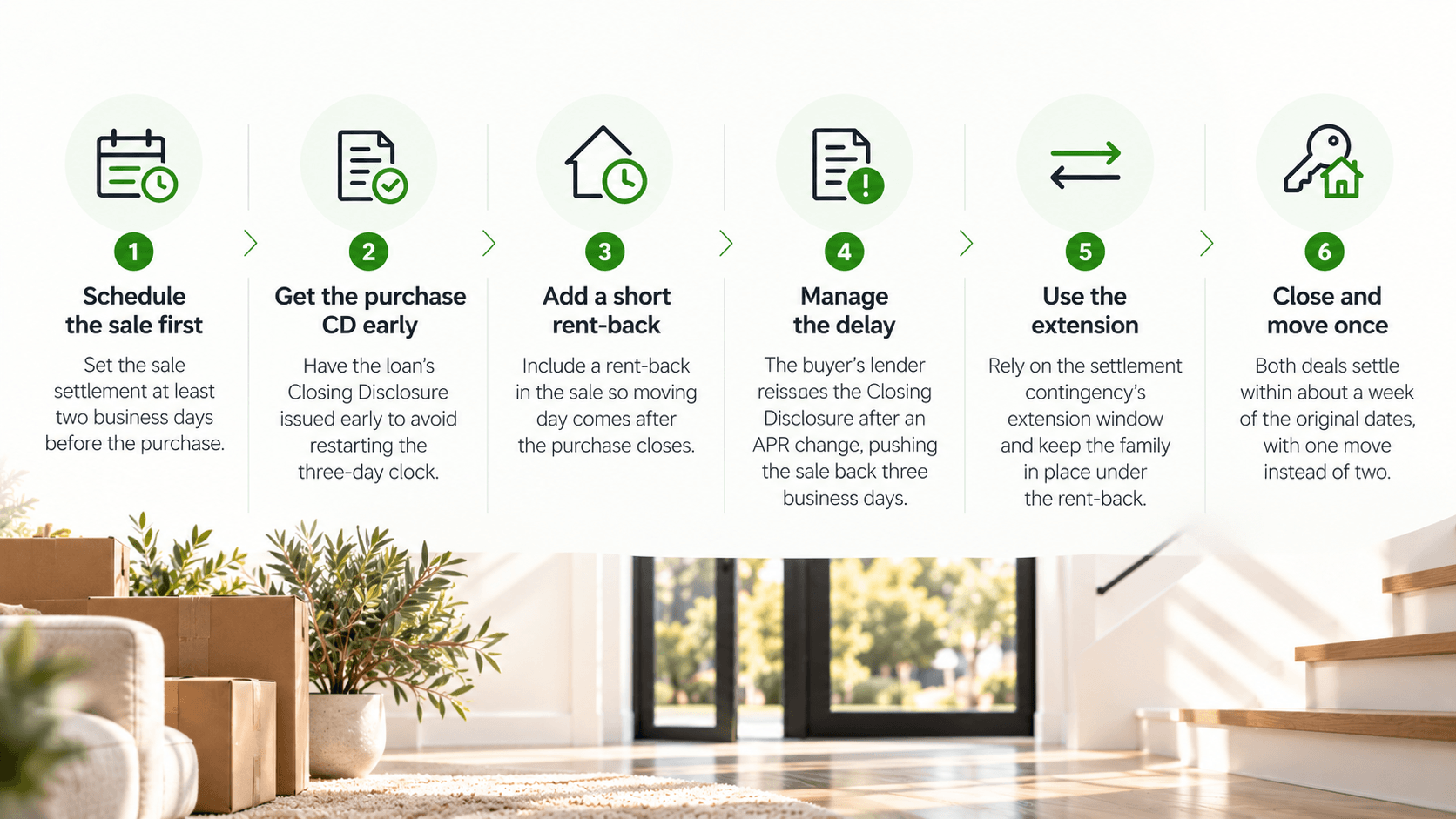
Illustrative example: how I line up a two-settlement week
Illustrative example based on my standard process. It describes no single client’s transaction.
I’m Michael Gorman, principal broker and Harvard MBA. Here is the order I follow for clients who are selling and buying home at same time Northern Virginia and need both deals to close in one week.
- Decision 1. Set the sale settlement at least two business days before the purchase settlement, so recorded, disbursed funds are ready.
- Decision 2. Get the purchase loan’s Closing Disclosure issued early, so a late change does not restart the three-day clock inside the gap.
- Decision 3. Write a short rent-back into the sale, so moving day comes after the purchase closes.
- The delay. The buyer’s lender reissues their Closing Disclosure after an APR change, which pushes the sale settlement back three business days.
- The response. We use the settlement contingency’s extension window on the purchase, keep the family in place under the rent-back, and settle who pays the rate-lock extension.
- The outcome. Both deals settle within about a week of the original dates, with one move instead of two.
What changes when downsizing?
Your purchase price usually drops. Your monthly costs may not. Compare total ownership costs, and read the association’s resale documents before your cancellation window closes.
Downsizing in Fairfax: a McLean house to a Reston condo (illustrative)
Illustrative example. The comparison is hypothetical. It shows what to check, and your actual costs will differ.
Picture owners selling a McLean single-family home and buying a Reston condo. Both are in Fairfax County. Here is what to line up side by side.
| What to compare | McLean house (selling) | Reston condo (buying) |
|---|---|---|
| Net equity | Sale price minus mortgage payoff, selling costs, and any tax due. | Purchase price plus closing costs. The gap is the equity you free up. |
| Accessibility | Stairs, a yard, and upkeep you handle yourself. | Check elevator access, step-free entry, and the walk from parking. |
| Moving and storage | Years of belongings in a larger footprint. | Budget for storage, donations, or furniture that fits smaller rooms. |
| Monthly dues | None, or a small HOA fee. | Dues can run from a few hundred dollars to more than $1,000 a month. |
| Assessments | Repairs are your call and your bill. | Special assessments and reserves appear on the resale certificate. |
Ask a CPA how your sale affects your taxes before you count your net equity. A lower price and a lower monthly cost are two separate tests. Association dues are usually paid straight to the association, outside your mortgage payment (CFPB, 2024). That makes them easy to leave out of a budget. Downsizing in Fairfax often means trading yard work for dues, so price both.
Read the resale certificate closely. In Virginia, it must show approved special assessments, reserves for capital expenditures, approved capital expenditures, and other fees owners owe (Va. Code § 55.1-2310, 2026).
Your cancellation right depends on timing. If you get the certificate before you ratify, you have three days from ratification to cancel. If you get it after, you have three days from receipt. If you never get it, you can cancel any time before settlement, without penalty (Va. Code § 55.1-2312, 2026).
Choice is improving for condo buyers. In August 2026, NVAR reported condo inventory up 44.8% from a year earlier in its core market (NVAR, 2026).
See what your current home could sell for.
Every plan in this guide starts with one number: what your current home is worth today. That number sets your cash to close, your loan approval, and which sequence fits.
If you use RealtyPeople on both sides, sellers pay a 1% listing commission ($500 + 1%) and buyers get 1% cash back at closing. On a $700,000 sale plus an $800,000 purchase, you can save about $18,000 across both deals.
Assumes a 2.5% seller-paid listing commission under a traditional model. Buyer cash back assumes the seller offers at least 1% in buyer-agent compensation and your lender allows the credit. Savings depend on the specific deal.
Request your Free Home Valuation Report. It is free, with no obligation.
Frequently asked questions
Can selling and buying home at same time Northern Virginia avoid two mortgages?
Yes, if you sell first or your sale is far enough along. When your current home settles before you buy, you carry one loan. If it has not settled, a lender following Fannie Mae’s rules usually counts both payments. The exception is an executed sale contract plus proof that your buyer’s financing contingencies are cleared.
Can I remain after selling?
Yes, if your buyer and your buyer’s lender agree to a rent-back in writing. The agreement should set the rent, deposit, move-out date, and who covers damage. The standard Virginia deed of trust (Fannie Mae/Freddie Mac Form 3047) requires the buyer to move in within 60 days, so your move-out date has to fit inside that window.
What if my buyer’s closing is delayed?
It depends on your purchase contract. A settlement contingency can let your purchase closing move by a capped number of days. Past that cap, you need a signed extension from your seller, so keep backup housing like a rent-back or short-term rental ready before settlement week.
Is winter ever a good time to list in Northern Virginia?
Yes, when inventory is scarce. Even January 2026 ran at just 1.10 months of supply. Fewer buyers are shopping, but the ones who are shopping in January are serious, and your listing is one of a few instead of one of many.

About Michael Gorman
Michael Gorman is the founder and Principal Broker of RealtyPeople in McLean, Virginia. He holds an MBA from Harvard Business School, has closed more than 2,000 transactions and $2 billion in volume over 24+ years in Northern Virginia, and has been an NVAR Top Producer at the Diamond level for 10+ consecutive years. Before founding the brokerage, he was Senior Vice President of Business Development at Long & Foster.
View profile →Compliance and disclosures: Equal Housing Opportunity. Licensed real estate brokerage in the Commonwealth of Virginia. This guide is general information, not legal, tax, or financial advice. Market data changes monthly. Verify current figures before you rely on them.
