
When you sell investment property in Northern Virginia, the sale price is only the first number. Your loan payoff, selling costs, depreciation history, and tax basis decide how much you keep.
Two owners can sell similar homes for the same price and walk away with far different results. One inherited the home last year. The other rented it out for two decades. The tax math for each sits miles apart.
We wrote this guide for investors and estate sellers. Michael Gorman, our founder and Principal Broker, has closed 2,000+ transactions and more than $2 billion in volume across Northern Virginia since 2001. That work includes rental sales, estate sales, and sales with several decision-makers at the table.
Below you will find the three routes open to you, the tenant questions, the cost and tax math, the inherited property rules, and the 1031 exchange deadlines. Treat it as general education. Your CPA and attorney handle tax and legal advice for your facts.
Sell investment property in Northern Virginia
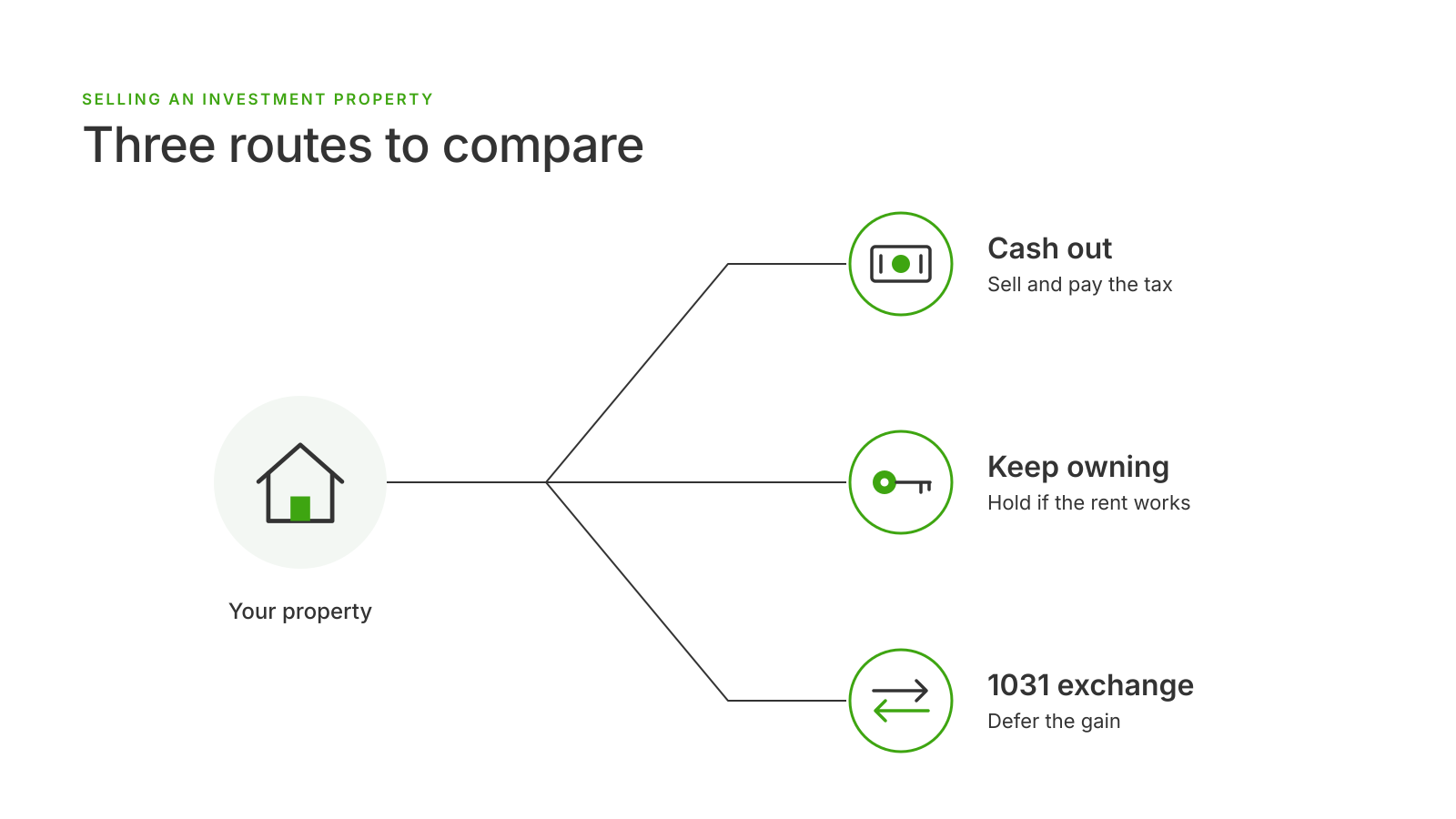
Before you list, compare three routes: cash out and pay the tax, keep owning, or exchange into another investment property. The right route depends on your after-tax proceeds, your timeline, and what you want the money to do next.
Most owners start with price. We start with purpose. A sale that funds retirement calls for a different plan than a sale that funds the next rental.
Cashing out
Cashing out is the simplest route. You sell, pay off the loan, pay the tax on your gain, and keep the rest with no deadlines attached.
This route suits owners who are done being landlords, heirs who need to divide proceeds, and anyone who values certainty over deferral. The trade-off is the tax bill, which can be large on a rental with years of depreciation behind it.
Cashing out also gives you the widest choice of what comes next. The money can pay down debt, fund retirement accounts, or sit in savings while you decide.
Continued ownership
Keeping the property is a real option, and it deserves a fair look. If the rent covers your costs, the home is in good shape, and you still have the energy to manage it, holding can beat selling.
Test it this way. Ask whether you would buy this same property today at its current value. If the answer is no, your equity may work harder somewhere else.
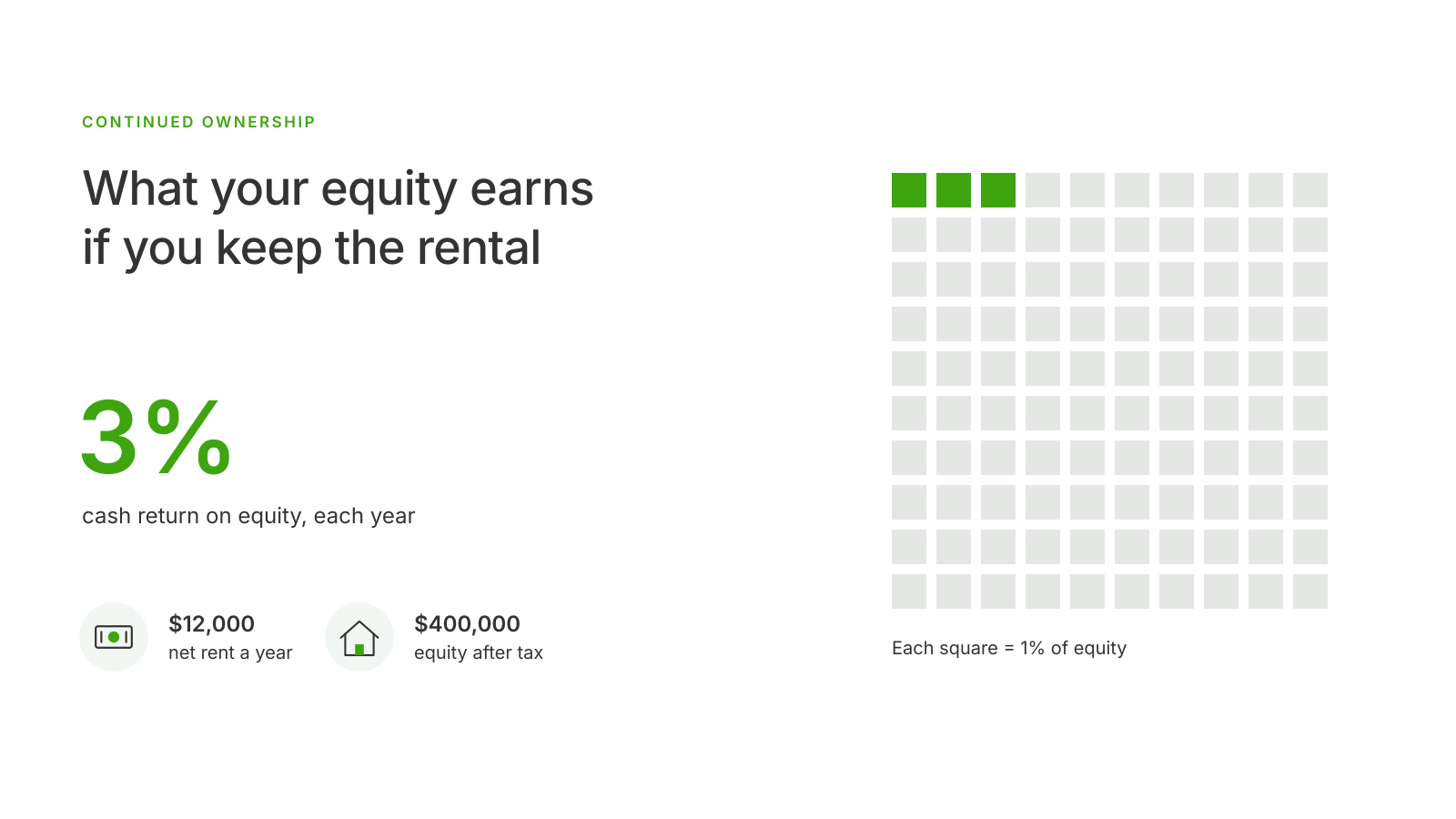
Compare the rent to the equity as well. If the home would net $400,000 after tax and the rent clears $12,000 a year after costs, your equity earns 3% in cash, plus whatever the home gains in value. That figure gives you a baseline for every other use of the money.
Count the full cost of holding too:
- Repairs coming due, such as the roof, HVAC, and windows.
- Turnover between tenants, with weeks of lost rent each time.
- Property taxes, insurance, and HOA or condo dues.
- Your own hours, or a property manager’s fee.
Holding also keeps one more door open. If you own the property at death, your heirs generally receive it with a basis reset to its value at that date. We explain that rule in the inherited property section.
Exchanging
A 1031 exchange lets you sell one investment property, buy another, and defer the eligible gain. Your equity stays invested in real estate.
It also adds strict deadlines, a required third party, and pressure to buy within months. An exchange is a tool for owners who want to stay invested. It is a weak reason to buy a property you would otherwise pass on.
The three routes can also blend. You can exchange most of your equity and take some cash, or sell one property outright and hold another. The numbers show which mix leaves you with the most after tax.
Run all three routes on paper before you choose. The rest of this guide gives you the inputs. Our selling page explains how we handle pricing, marketing, and negotiation once you decide to list.
Selling rental property with tenants Virginia
You can sell a rental with tenants in place. In most cases the lease stays in force and the buyer becomes the new landlord, so the lease terms shape your price, your buyer pool, and your timeline.
Selling rental property with tenants in Virginia goes more smoothly when you sort out five items before the listing goes live.
- Lease review. Read the lease end date, the renewal terms, and any clause about a sale or early termination. A month-to-month tenancy and a lease with ten months left create two different sales.
- Access arrangements. Photos, showings, inspections, and the appraisal all need entry. Your lease and Virginia law set the notice rules. Agree on a showing schedule with the tenant early, and put it in writing.
- Deposits. Virginia Code § 55.1-1213 requires the current owner to transfer security deposits, with any accrued interest, to the new owner at the time of transfer. The settlement company handles this as a credit to the buyer.
- Rent roll. Investor buyers want proof: the signed lease, the payment history, the deposit amount, and a list of recent repairs. Clean records support your price.
- Vacancy costs. If you plan to sell the home empty, price the months without rent, plus the mortgage, taxes, dues, and utilities you carry during that time.
Virginia also requires notice of the sale. Under § 55.1-1216, the landlord notifies the tenant of the sale and provides the buyer’s name, address, and phone number.
The lease also gives you three ways to time the sale:
- Sell with the lease in place. The buyer takes the property with the tenant. Investor buyers expect this. Most owner-occupant buyers need the home empty at closing or soon after.
- Wait for the lease to end. You give proper notice under the lease, the tenant moves out, and you prepare the home for the widest buyer pool.
- Agree on an early move-out. Some tenants will leave early in return for a payment or a rent credit. Put the agreement in writing and have counsel review it.
Have a Virginia attorney review your lease and your plan before you list. Tenant rights turn on the exact lease language and on current law. A short review costs far less than a dispute at closing.
Occupied or vacant: a Fairfax townhouse comparison
An occupied sale and a vacant sale reach different buyers. A tenant in place appeals to investors, who price the home on its rent. A vacant, prepared home appeals to owner-occupants, who often pay more.
Here is an illustration with round numbers for a Fairfax townhouse rented at $3,200 a month.
- Vacant route. You wait for the lease to end, spend $12,000 on paint, flooring, and repairs, and expect a $650,000 sale. Two months without rent cost $6,400. Carrying costs for those months add $7,000. Total cost: $25,400.
- Occupied route. You sell now to an investor at $630,000 with the tenant in place. You skip the prep and the vacancy.
The vacant route nets $624,600 before selling costs. The occupied route nets $630,000. In this illustration, the lower price wins by $5,400.
Change one input and the answer flips. If the vacant price were $670,000, the vacant route would win by $14,600.
That is why we price both routes for a rental before recommending either one. Each route needs its own set of comparable sales: recent investor purchases for the occupied price, and recent owner-occupant purchases for the vacant price.
The tenant’s cooperation matters as well. A tenant who keeps the home tidy and allows showings protects your price. Some owners offer a rent credit or moving help in return for flexibility, with the terms set in writing.
Selling costs and after-tax proceeds
Closing cash and taxable gain are two separate numbers. Closing cash is what the settlement company wires you after the loan payoff and costs. Taxable gain is what the IRS measures, and your loan balance plays no part in it.
Mixing the two leads to surprises at tax time. Work out each one on its own line.
What comes out at closing
When you sell investment property in Northern Virginia, the settlement statement subtracts these items from the sale price:
- Debt payoff. The remaining mortgage balance, plus any second loan or line of credit.
- Commissions. The listing fee, plus the buyer’s agent fee when the buyer asks you to pay it. Buy-side fees commonly run 2.5% to 3% of the price.
- Repairs. Prep work before listing and items negotiated after the buyer’s inspection.
- Concessions. Credits toward the buyer’s closing costs.
- Taxes. Virginia transfer taxes and prorated property taxes at settlement. Income tax on the gain comes later, with your return.
Our guide to the total cost to sell a home in Northern Virginia breaks down each closing line.
The listing fee is the line you control most. With RealtyPeople, sellers pay $500 + 1%. On a $700,000 rental, that is $7,500 against $17,500 at a typical 2.5% listing fee, so you can save about $10,000. Assumes a 2.5% seller-paid listing commission under a traditional model.
How the IRS measures gain
IRS Publication 544 sets the formula. Your gain equals the amount you realize minus your adjusted basis.
The amount realized is the sale price minus your selling expenses. Adjusted basis starts with what you paid, rises with improvements, and falls with depreciation.
Depreciation is the piece rental owners forget. Each year of depreciation lowered your basis, which raises your gain at sale.
Here is an illustration for a long-held rental:
- Purchase price: $400,000
- Improvements over the years: $30,000
- Depreciation taken: $120,000
- Adjusted basis: $310,000
- Sale price: $700,000, with $45,000 in selling expenses
- Amount realized: $655,000
- Taxable gain: $345,000
Now add a $250,000 mortgage. Closing cash is $700,000 minus $45,000 minus $250,000, or $405,000. The gain stays at $345,000. Paying off the loan changes your cash and leaves your tax the same.
Owners who refinanced and pulled cash out feel this most. A large loan can leave modest cash at closing while the full gain is still taxed.
How the gain is taxed
The IRS taxes most long-term gains at 0%, 15%, or 20%, based on your taxable income, per IRS Topic 409. The part of your gain tied to depreciation on real property can be taxed at a rate of up to 25%.
In the illustration above, $120,000 of the gain traces to depreciation and $225,000 to appreciation. A net investment income tax can apply at higher incomes, and state income tax applies as well.
Your after-tax proceeds are the closing cash minus the tax your CPA estimates. That single figure is what you compare across cashing out, holding, and exchanging.
Records to gather first
Your CPA can only be as accurate as your paperwork. Pull these together before you ask for an estimate:
- The settlement statement from your purchase.
- Receipts for improvements, such as a new roof, an addition, or a kitchen remodel.
- The depreciation schedules from your past tax returns.
- Your current loan statements, including any line of credit.
- The lease, the rent history, and the security deposit record.
Ask your CPA for a written estimate built on your real basis records. Old settlement statements are the starting point, which is why we tell every client to keep the ALTA settlement statement from each purchase and sale.
Inherited property tax basis
Inherited property generally takes a tax basis equal to its fair market value on the date of death. That reset often erases decades of gain, which changes the whole sale decision for heirs.
The IRS guidance on inheritances states the general rule and its exceptions. An executor who files an estate tax return can elect an alternate valuation date. In some estates, heirs who receive a Schedule A to Form 8971 must report a basis consistent with the estate tax value.
The executor is your source for the date-of-death value. Ask for the inherited property tax basis in writing. If no appraisal exists, order one soon. A dated appraisal from a licensed appraiser is the record your CPA will ask for.
An inherited McLean home and a long-held rental
Picture one house in McLean and two different owners.
The first owners are siblings who inherit the house. Their parents paid $300,000 decades ago. The value on the date of death is $1,500,000. Six months later, the siblings sell for $1,520,000 and pay $95,000 in selling expenses.
Their amount realized is $1,425,000. Their basis is $1,500,000. On paper they show a $75,000 loss and zero taxable gain. Whether that loss is deductible depends on how they used the home, which is a question for their CPA.
The second owner bought the same house for $300,000, rented it for 25 years, and took $200,000 in depreciation. The adjusted basis is $100,000. The same sale produces a $1,325,000 gain.
Same house, same price, same week. One sale carries zero taxable gain. The other carries a seven-figure gain. These are illustrations with round numbers, and your own figures will differ.
What the basis reset means for heirs
Heirs hear exchange pitches often. With a basis reset to current value, there is usually little gain to defer. An exchange then adds cost, deadlines, and pressure in return for a small benefit.
An exchange can still make sense for an heir in some cases. The property may have kept running as a rental for years after the death and gained value. Or the heir may want to stay invested in real estate.
We never recommend an exchange automatically. We ask for the basis first.
Some inherited homes come with a tenant already in place. In that case, the lease steps from the section above apply to the estate as well, and the rent history becomes part of the sale file.
Heirs who sell investment property in Northern Virginia soon after inheriting it often find that selling costs are the larger number and income tax is the smaller one. That makes the listing fee, the prep budget, and the price strategy the main levers.
Estate sales carry other moving parts:
- Authority to sell. The title company needs to see who can sign: the executor, the trustee, or all of the heirs.
- Timing. The market value drifts from the date-of-death figure as months pass, and any gain or loss drifts with it.
- Condition. Heirs choose between an as-is sale, light prep, or full repairs. Each choice produces a different net.
- Co-heirs. Agree in writing on the price range, the repair budget, and who makes decisions before you list.
A calm, documented process keeps families out of conflict. One point of contact for the attorney, the CPA, and each heir saves weeks.
1031 exchange Northern Virginia
A 1031 exchange defers eligible gain when you trade real property held for investment or business use for other like-kind real property. You have 45 days to identify a replacement, and you must receive it by day 180 or your tax return due date, including extensions, whichever comes first.
Those deadlines come from the IRS instructions for Form 8824, the form you file to report the exchange.
What qualifies
Both properties must be real property held for investment or for use in a trade or business. A rental townhouse, a small apartment building, and rental land can all be like-kind to each other. The IRS generally treats improved and unimproved real property as like-kind.
Some property falls outside the rule:
- Your personal residence.
- Property held primarily for sale, such as a flip.
- Real property outside the United States, when the property you sell is inside it.
A 1031 exchange in Northern Virginia carries no local boundary. You can sell in Fairfax and buy in Loudoun, in Prince William, or in another state.
The 45-day and 180-day clocks
Both clocks start the day you transfer the property you are selling. They run at the same time.
Within 45 days, you identify the replacement property in a signed, written document. The description must be clear, such as a street address. You deliver it to the person obligated to transfer the replacement or to another party to the exchange, such as your intermediary.
You must then receive the replacement by the earlier of two dates: 180 days after the transfer, or the due date of your tax return for that year, including extensions.
That second date catches people. Say you close on December 1, 2026. Day 45 lands on January 15, 2027. Day 180 lands on May 30, 2027.
Your return is due April 15, 2027, which comes first. To use the full 180 days, you file an extension.
A slow lender or a seller who backs out leaves the deadlines where they are. Have your intermediary confirm your exact dates in writing on the day you close.
Who does what in an exchange
An exchange is a team effort, and each role is separate:
- Qualified intermediary. Prepares the exchange documents and holds the sale proceeds between closings.
- CPA. Calculates your gain, tests for boot, and reports the exchange on Form 8824.
- Attorney. Reviews the contracts, the title, and any lease or estate issues.
- Broker. Prices and sells the property you are giving up, adds exchange language to the contracts, and helps you find and negotiate the replacement.
Bring the team together before you list. Once the sale closes, the 45-day clock leaves little room for introductions.
What deferral means
Deferral postpones the tax. It leaves the gain in place. Your old basis carries into the replacement property, so the deferred gain waits there until a later taxable sale.
An exchange can also be partial. If you keep some cash out of the deal, the exchange still stands and you pay tax on the part you kept. Some owners choose this on purpose to free up money while deferring most of the gain.
You also report the exchange. Form 8824 goes in with your return for the year you transferred the property.
Replacement purchases and exchange risks
An exchange can fail on logistics long before it fails on price. Plan these five items before your sale closes.
- Intermediary before closing. A deferred exchange runs through a qualified intermediary. Engage one before settlement, so the exchange documents are in place when the deed transfers. The IRS bars related parties and your own agents from the role.
- Proceeds control. The intermediary holds the sale proceeds. If the money reaches your account, even briefly, the exchange can fail and the gain becomes taxable.
- Taxable boot. Cash or other property you receive in the exchange is called boot. You recognize gain up to the amount of boot you receive.
- Financing. Debt counts. If your old loan is paid off and you borrow less on the replacement, the difference can count as boot unless you add cash. Line up your replacement loan early.
- Investment-use eligibility. The replacement must be held for investment or business use. Buying a home you plan to move into puts the exchange at risk.
Choose the intermediary with the same care you give the purchase. This company will hold your sale proceeds for up to six months. Ask how the funds are held, whether your money sits in a separate account, and what protection applies if the company fails. The IRS instructions address intermediary bankruptcy for a reason.
One more rule matters for family deals. If you exchange with a related party and either side disposes of its property within two years, the deferred gain generally comes due.
A Fairfax to Prince William replacement plan
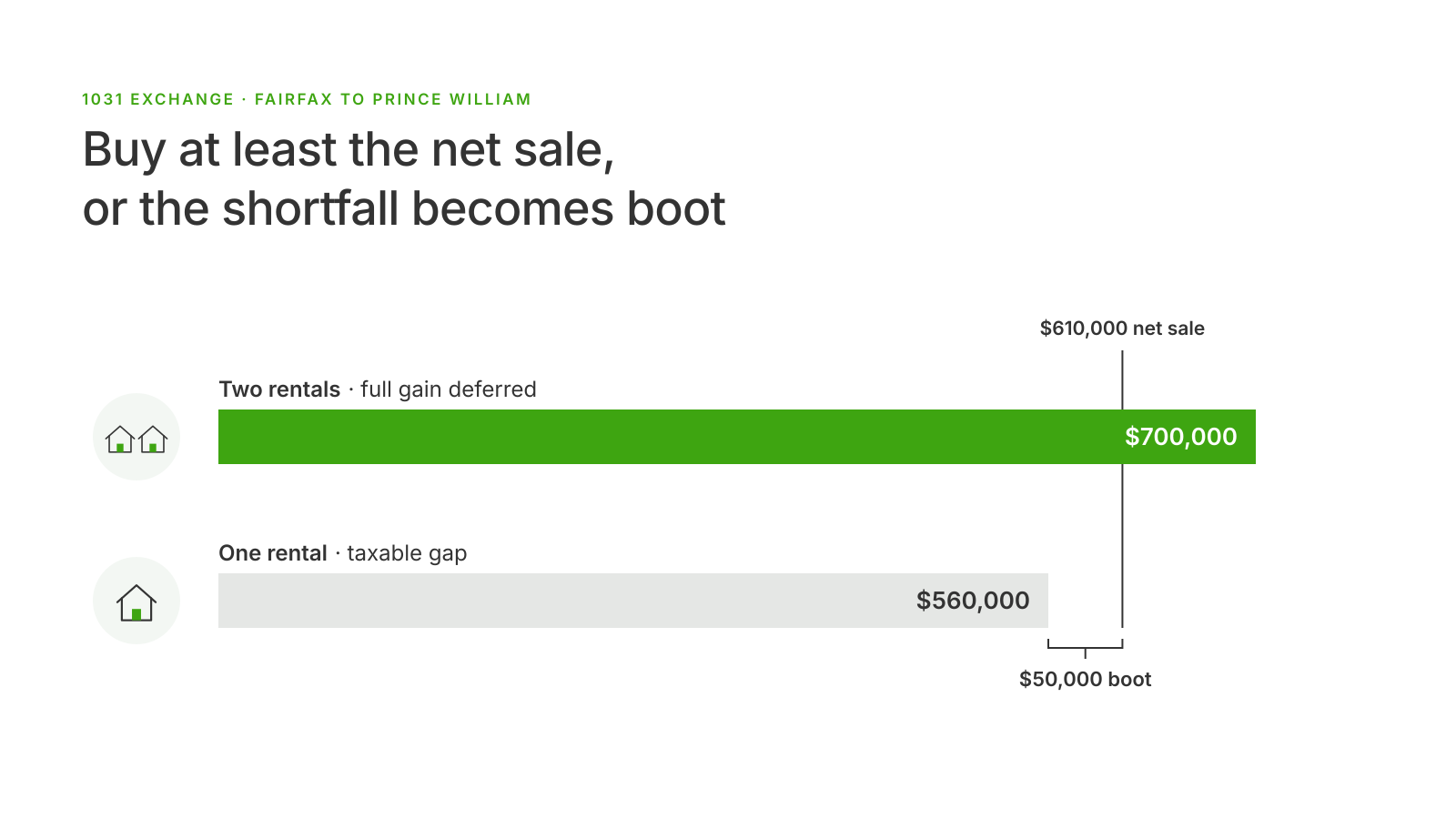
Here is an illustration. An owner sells a Fairfax rental for $650,000. After $40,000 in selling costs, the net sale is $610,000. The loan payoff is $240,000, so $370,000 goes to the intermediary.
The owner wants two smaller rentals in Prince William County, which spreads the rent across two tenants. The plan runs in three stages.
- Before closing: hire the intermediary, get a lender pre-approval, and tour target areas such as Woodbridge and Manassas.
- By day 45: identify the replacement properties in writing.
- By the receipt deadline: close on both purchases.
If the two purchases total $700,000, the owner has traded up. With $370,000 down and $330,000 in new loans, the owner has replaced the value, the equity, and the debt. The full gain can be deferred.
If the owner buys one property at $560,000 and stops, the purchase falls $50,000 short of the $610,000 net sale. That shortfall comes back as boot, and gain is taxable up to that amount.
The harder risk is the purchase itself. A deadline can push you to overpay or to accept a weak property. Start shopping before you list, and set a price ceiling for each target.
Read the local market before you commit to a search area. Our Northern Virginia housing market report tracks prices and inventory by quarter.
If no property meets your standard by day 45, paying the tax can be the better outcome. A deferred gain on a bad purchase is still a bad purchase.
Establish the numbers before listing
Establish the property’s value first, then have your CPA calculate the tax on each route. With those two numbers, the choice between cashing out, holding, and exchanging becomes simple arithmetic.
Michael Gorman is a Virginia Principal Broker and Harvard MBA with 24+ years in Northern Virginia real estate and 2,000+ transactions. On investment and estate sales, we coordinate directly with your CPA and attorney, so the pricing, the tax estimate, and the legal review line up before the listing date.
Three points to carry with you:
- Closing cash and taxable gain are separate numbers. Your loan payoff changes the first and leaves the second alone.
- Inherited property usually starts with a basis near current value, so heirs often owe little tax and gain little from an exchange.
- A 1031 exchange defers eligible gain only when the intermediary, the 45-day identification, and the receipt deadline are all handled on time.
If you own a rental or an inherited home and you keep circling the same decision without real figures, you are where most owners start.
Before you sell investment property in Northern Virginia, get the value on paper. Request your Free Market Analysis Report. We will show you what the property could sell for in today’s market, and you can take that number straight to your CPA.
Frequently asked questions
Can I sell investment property in Northern Virginia with tenants?
Yes. You can sell with a tenant in place, and the lease generally stays in force with the buyer as the new landlord. Review the lease, plan showing access, transfer the deposit at closing, and have a Virginia attorney confirm the details.
Does mortgage payoff reduce taxable gain?
No. Your loan payoff reduces the cash you receive at closing and leaves your taxable gain unchanged. The IRS measures gain as the amount realized minus your adjusted basis, so the loan balance stays out of the formula.
Can inherited property qualify for an exchange?
Yes, when the heir holds it for investment or business use, such as a rental. Inherited property generally takes a basis equal to its date-of-death value, so the gain is often small. Ask your CPA whether an exchange is worth the cost.
Can a replacement become my primary residence?
Only with care. The replacement must be acquired and held for investment or business use. Moving in soon after closing can put the deferral at risk. Ask your CPA how long to rent it first and which records to keep.

About Michael Gorman
Michael Gorman is the founder and Principal Broker of RealtyPeople in McLean, Virginia. He holds an MBA from Harvard Business School, has closed more than 2,000 transactions and $2 billion in volume over 24+ years in Northern Virginia, and has been an NVAR Top Producer at the Diamond level for 10+ consecutive years. Before founding the brokerage, he was Senior Vice President of Business Development at Long & Foster.
View profile →Compliance and disclosures: Equal Housing Opportunity. Licensed real estate brokerage in the Commonwealth of Virginia. This guide is general information, not legal, tax, or financial advice. Market data changes monthly. Verify current figures before you rely on them.
