
A 1031 exchange real estate agent in Virginia has a defined job: sell the property you are giving up at the right price, and help you buy the replacement on time. The exchange itself is run by someone else.
Investors often expect one person to handle everything. That expectation causes trouble. The IRS bars your agent from holding the money, and a missed handoff between roles can cost you the whole deferral.
Michael Gorman, our founder, is a Virginia Principal Broker and Harvard MBA with 24+ years in Northern Virginia real estate and 2,000+ transactions. This guide explains who does what, which Virginia safeguards apply, and how to pick an agent for an exchange. Treat it as general education. Your CPA and attorney handle tax and legal advice for your facts.
1031 exchange real estate agent in Virginia: Core responsibilities
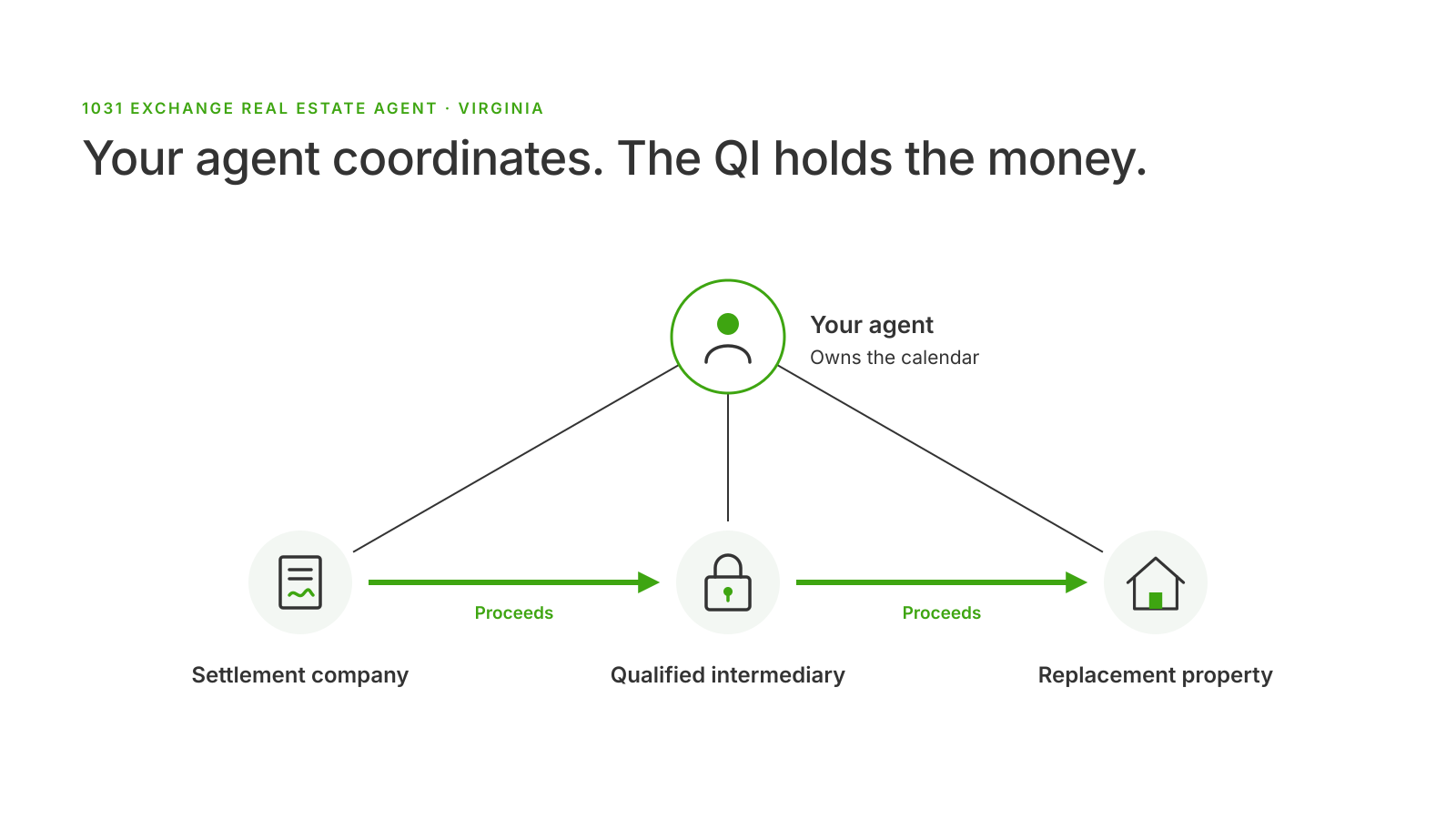
The agent handles valuation, marketing, the replacement search, and negotiations on both transactions. A qualified intermediary handles the exchange mechanics and holds the funds. Keep those two jobs separate.
What the agent handles
- Valuation. A price for the property you are selling, built on comparable sales. The number sets how much equity moves into the replacement.
- Marketing and sale. Listing, showings, offers, and a closing date that suits the exchange.
- Contract language. A clause telling the buyer the sale is part of an exchange and asking for cooperation, at no cost to the buyer.
- Replacement search. Finding, touring, and comparing investment properties before and after the sale closes.
- Negotiation. Price, terms, inspection items, and closing dates on both sides.
- Coordination. Keeping the intermediary, the lender, the settlement company, and your CPA on the same calendar.
What the qualified intermediary handles
The qualified intermediary, often called a QI, prepares the exchange agreement, receives the sale proceeds at closing, holds them, and releases them to buy the replacement. The QI also receives your written identification of replacement property.
Your agent is barred from this role. The IRS instructions for Form 8824 treat a taxpayer’s agents as disqualified persons. The IRS lists real estate agents and brokers, attorneys, accountants, and employees who served you in the previous two years.
So an agent who offers to hold your proceeds, or to act as your intermediary, is offering something the rules forbid.
CPA, attorney, and settlement company
- CPA. Calculates your basis and gain, tests the deal for taxable boot, and reports the exchange on Form 8824.
- Attorney. Reviews contracts, title, entity ownership, and any lease or estate questions.
- Settlement company. Closes each transaction and wires the sale proceeds to the QI under the exchange documents.
Each one answers a different question. Ask the tax questions of the CPA and the legal questions of the attorney. A good agent tells you when a question belongs to someone else.
Where the handoffs break
Exchange problems often start between roles. The settlement company learns about the exchange on closing day and wires the proceeds to the seller. The QI is hired after the deed transfers. The lender for the replacement hears about the deadline in week ten.
The agent sits in the middle of all of these parties, which makes coordination a core part of the job. Ask who on your team owns the calendar. The answer should be one named person.
Our guide to selling investment property in Northern Virginia covers the wider tax picture, including costs and inherited property.
Qualified intermediary Virginia: Safeguards
Virginia regulates exchange facilitators under the Exchange Facilitators Act. The law sets minimum protections for your money, and you should know both what it requires and where it stops.
The Virginia Exchange Facilitators Act covers intermediaries that handle exchanges of Virginia property. Its main requirements:
- Insurance or security. The facilitator must carry errors and omissions insurance of at least $250,000, or deposit cash or irrevocable letters of credit of at least that amount.
- Account controls. Exchange funds sit in a separately identified account where a withdrawal needs your written authorization and the facilitator’s written acknowledgment, or in a qualified escrow or trust account.
- Separation of funds. The facilitator must keep your funds apart from its operating accounts. Commingling is prohibited, and so are loans to related parties.
- Creditor protection. Exchange funds are shielded from execution or attachment on claims against the facilitator.
- Change of control. If the company changes hands, clients must be notified within 10 business days.
The law also addresses interest. Earnings on the funds accrue as your written exchange agreement provides, so read that clause and know who keeps the interest.
Insurance is a floor
A $250,000 policy is a minimum, and it differs from a promise that you will be made whole. Many Northern Virginia exchanges hold far more than that. Errors and omissions coverage also responds to mistakes, which is a narrower thing than every possible loss.
The IRS has warned that some intermediaries have gone bankrupt or failed to meet their obligations, causing clients to miss deadlines and lose the deferral.
Questions to put to the intermediary
- Which bank holds the funds, and in what kind of account.
- Whether your money sits in its own account under your tax ID.
- Who must sign to release funds, and how you give that authorization.
- How much insurance or security the company carries above the legal minimum.
- How many Virginia exchanges it completed in the past year.
Get the answers in writing and read the exchange agreement before you sign it. Your agent can introduce established intermediaries. The choice, and the review, stay with you and your attorney.
1031 exchange timeline
Set up the exchange before your sale closes. The closing starts two deadlines that run at the same time, and the IRS allows no extension for hardship. The one exception is a presidentially declared disaster.
The rules come from the IRS. You identify replacement property within 45 days of transferring the property you sold. You receive the replacement within 180 days, or by the due date of your tax return for that year, including extensions, whichever arrives first.
A working sequence looks like this:
- Before listing. Meet your CPA, confirm the property qualifies, and get a gain estimate. Interview intermediaries. Start touring replacement areas.
- At listing. Add exchange cooperation language to the listing and the contract.
- Before closing. Sign the exchange agreement with the QI. Give the settlement company the QI’s instructions. Obtain a lender pre-approval for the replacement.
- Closing day. Proceeds go straight to the QI. Day zero.
- By day 45. Deliver your signed, written identification to the QI.
- By day 180 or your return due date. Close on the replacement.
- At tax time. Your CPA files Form 8824 with your return.
Here is how the dates fall. Close on February 1, 2027, and day 45 lands on March 18, 2027. Day 180 lands on July 31, 2027. Have your intermediary confirm the exact dates in writing.
Your closing date is a choice, and it sets everything that follows. Your agent can negotiate a closing that gives you the most useful 45 days, such as avoiding a window that runs through the winter holidays, when fewer properties come to market.
Write the 1031 exchange timeline on one page and send it to the intermediary, the lender, the settlement company, and your CPA. Everyone should be working from the same dates.
A sale late in the year needs extra care. The return due date in April can arrive before day 180, and an extension may be required to keep the full period.
Between closing and day 45, expect weekly contact from your agent: new listings that meet your criteria, tours, rent comparables on each candidate, and a running count of the days left.
The order of the first three steps is the point. A 1031 exchange real estate agent in Virginia does the most valuable work before closing, when there is still time to line up the intermediary, the lender, and a short list of replacements. Once the deed transfers, the clock controls the deal.
1031 replacement property: Search before the sale
Start the replacement search while your property is still on the market. Forty-five days is too short to learn a new submarket, tour homes, and compare returns from a standing start.
A hypothetical: Fairfax rental to Prince William
This example is hypothetical and uses round numbers. An investor owns a rental townhouse in Fairfax County and plans to sell for about $650,000. She wants to exchange into two rentals in Prince William County.
Her agent builds the plan around four items before the Fairfax sale closes:
- Shortlist alternatives. She tours Woodbridge and Manassas and ranks six candidate properties, so she has backups if her first choices go under contract.
- Financing. She gets a pre-approval sized to the replacement purchases, so the lender is ready when she is.
- Inspections. She learns which candidates need roofs, HVAC systems, or other large repairs, and prices that into her offers.
- Closing availability. Her agent asks each seller’s side how fast they can close, since a seller who needs 90 days eats half of her 180.
When the Fairfax sale closes, she already knows her top candidates and their numbers. She identifies them in writing in the first two weeks and has time left to negotiate.
Negotiation changes under a deadline too. A seller who learns that you must close within weeks may hold firm on price. Your agent should share your timing only where it helps you, such as offering a fast closing the seller values.
Treat each candidate as an investment first. A 1031 replacement property still has to earn its place on rent, condition, and price. The deferral is a benefit of a good purchase and a poor excuse for a weak one.
Identification goes to the right party
The identification must be in writing, signed by you, and delivered to a person involved in the exchange, such as the qualified intermediary or the seller of the replacement property.
Telling your own agent falls short. The IRS fact sheet on like-kind exchanges states that notice to your attorney, real estate agent, or accountant is insufficient. An email to your agent listing three addresses leaves you without a valid identification.
Your agent can help you prepare the list with clear street addresses. You sign it, and it goes to the QI before midnight on day 45. Keep the QI’s written confirmation of receipt.
Read the market before you pick a search area. Our Northern Virginia housing market report tracks prices and inventory by quarter.
Agent selection evidence and tax-adviser checkpoints
Ask any agent for documented exchange coordination and for local underwriting evidence on the replacement. Experience selling homes is common. Experience keeping an exchange on schedule is rarer, and you can test for it.
Evidence to request from the agent
- Recent examples. Exchange transactions from the past few years, with the dates of the sale and the replacement purchase.
- Individual role. Whether this agent ran the sale, the purchase, or both.
- QI coordination. How the agent worked with the intermediary and the settlement company, and when each was brought in.
- Rents. Current rent comparables for the replacement, with sources.
- HOA restrictions. Rental caps, lease minimums, or approval rules that could block your plan to rent the property.
- Reserves. The condition of the roof, systems, and, for condos, the association’s reserve funding.
Then ask three plain questions. What went wrong on your last exchange, and how did you fix it. When do you bring in the intermediary. What do you do if my first-choice replacement falls through on day 30.
The last three separate an investment purchase from a home purchase. A replacement that you are barred from renting, or that needs $40,000 of work in year one, is a poor trade for a tax deferral.
Our guide on how to choose the best realtor in Northern Virginia covers the general checks that apply to any agent.
Checkpoints for your CPA
Take the numbers to your CPA at three points: before listing, before you sign a replacement contract, and before closing.
The main risk is boot. If you receive cash from the exchange, or if your debt is paid off and you take on less debt in the replacement, the IRS can treat the difference as recognized gain. Your CPA tests each proposed purchase for that result.
Your agent supplies the inputs: the expected sale price, selling costs, the replacement price, and the loan amount. The CPA supplies the answer.
Estate sellers: check the basis first
Heirs should confirm two things with a CPA before anyone recommends an exchange. The first is basis. Under IRS Publication 551, inherited property generally takes a basis equal to its fair market value at the date of death. A sale soon after may carry little gain to defer.
The second is eligibility. An exchange requires property held for investment or business use. A home that sat empty or was used by family may fall outside the rule.
A 1031 exchange real estate agent in Virginia who works with estates raises both questions early and sends you to the CPA for the answers.
The listing fee affects exchange equity
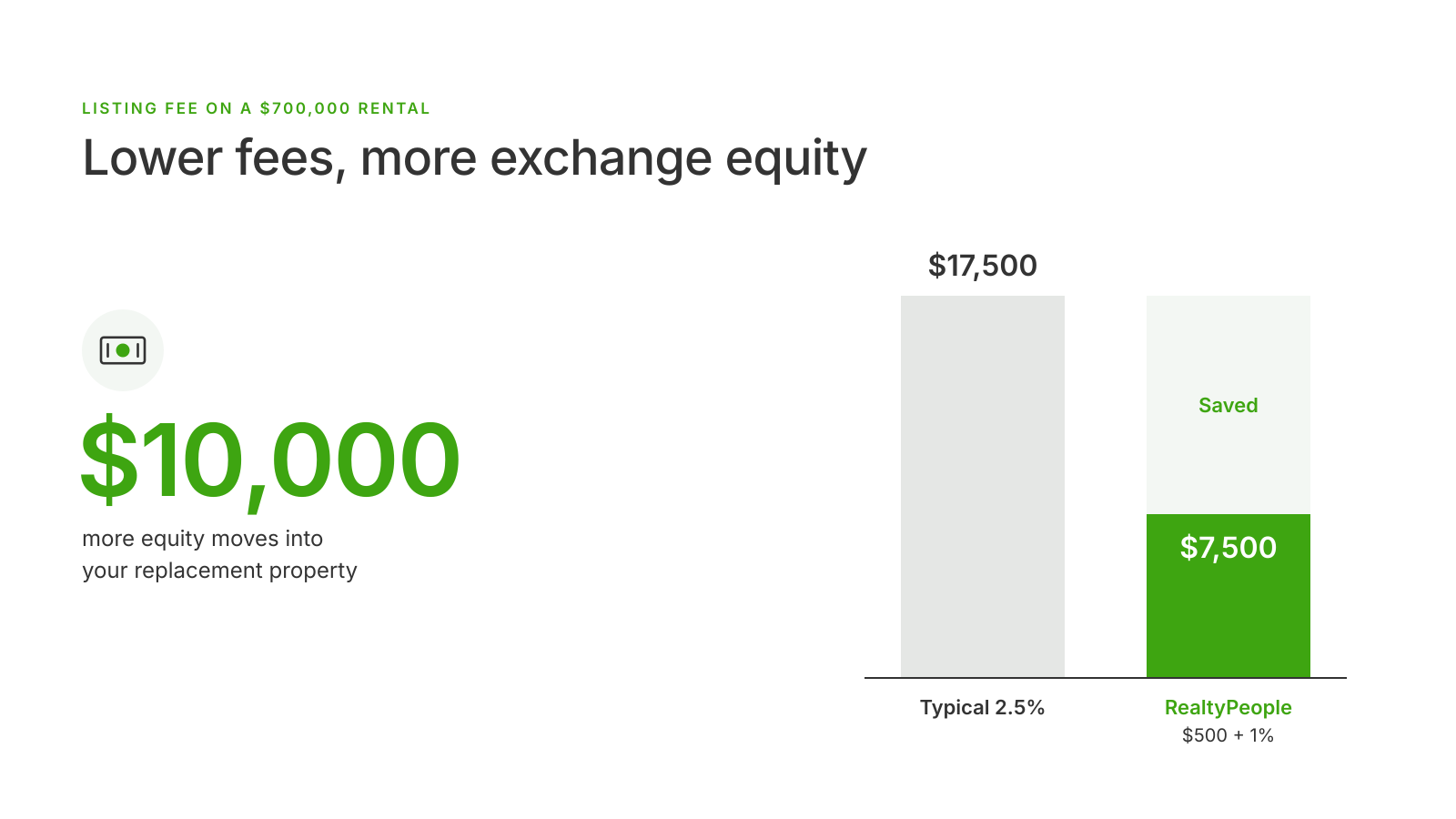
Selling costs reduce the equity that moves into your replacement. With RealtyPeople, sellers pay $500 + 1%. On a $700,000 rental, that is $7,500 against $17,500 at a typical 2.5% listing fee, so you can save about $10,000. Assumes a 2.5% seller-paid listing commission under a traditional model.
Establish value before committing to an exchange
Confirm the sale economics and the replacement options before you list. An exchange is worth the effort only when the expected sale price, the tax at stake, and the available replacements all support it.
Michael Gorman has closed 2,000+ transactions since 2001 across residential and investment property. Exchanges are one part of that work. On an exchange, we handle the pricing, the sale, and the replacement search, and we coordinate with your intermediary, CPA, and attorney.
Three points to carry with you:
- Your agent sells and buys. The qualified intermediary holds the funds and runs the exchange. The IRS keeps those roles apart.
- Virginia sets minimum safeguards for intermediaries. Review the account controls and the agreement yourself.
- The 45-day and 180-day deadlines start at closing, so the planning happens before you list.
If you own a rental and keep asking whether an exchange is worth it, the first missing number is usually what the property would sell for today.
Start there. Request your Free Market Analysis Report and take the figure to your CPA. When you are ready to list, our selling page explains how we work.
Frequently asked questions
How do I choose a 1031 exchange real estate agent in Virginia?
Ask for documented exchange transactions, the agent’s own role in each, and how they coordinated with the intermediary. Then ask for rent comparables and HOA rental rules on a sample replacement. Choose the agent who shows evidence for both.
Can my agent also be my QI?
No. The IRS treats your agents as disqualified persons, including a real estate agent or broker who has acted for you in the previous two years. The qualified intermediary must be an independent party that holds the exchange funds.
Can inherited property qualify?
Yes, if the heir holds it for investment or business use, such as a rental. Inherited property generally takes a basis equal to its value at the date of death, so the gain may be small. Have a CPA check both points first.
What happens if replacement financing fails?
The deadlines stay in place. If you are unable to close on an identified property in time, the exchange fails and the gain becomes taxable. Reduce the risk with an early lender pre-approval and by identifying backup properties within the 45 days.

About Michael Gorman
Michael Gorman is the founder and Principal Broker of RealtyPeople in McLean, Virginia. He holds an MBA from Harvard Business School, has closed more than 2,000 transactions and $2 billion in volume over 24+ years in Northern Virginia, and has been an NVAR Top Producer at the Diamond level for 10+ consecutive years. Before founding the brokerage, he was Senior Vice President of Business Development at Long & Foster.
View profile →Compliance and disclosures: Equal Housing Opportunity. Licensed real estate brokerage in the Commonwealth of Virginia. This guide is general information, not legal, tax, or financial advice. Market data changes monthly. Verify current figures before you rely on them.
