The first time home buyer programs Virginia offers in 2026 fall into three buckets: state programs through Virginia Housing, federal loan programs (FHA, VA, and USDA), and county-level down payment assistance in Northern Virginia. Most buyers qualify for more than one and use none of them.
That is the expensive part. Virginia Housing’s grants are never repaid. Loudoun forgives its loan over 15 years. Alexandria goes to $50,000. Buyers walk past all of it because nobody hands them the list.
First-time buyers were just 21% of all buyers last year, the lowest share NAR has recorded since 1981, and the median first-time buyer is now 40, per the NAR 2025 Profile of Home Buyers and Sellers. Nobody is aging into a first home by accident.
Below is the full list with eligibility numbers, what stacks with what, and a $600,000 cost comparison. It is what we walk first-time buyers through at RealtyPeople before they tour a house. For the buyer-side picture, start with buying a home in Northern Virginia with 1% cash back.
First Time Home Buyer Programs Virginia at a Glance
Nine programs matter in 2026. Here is what each requires.
| Program | Min credit | Min down | Income cap | First-time required? |
|---|---|---|---|---|
| Virginia Housing Conventional | 640 | 3% | VH bond limits, $186,000 / $217,000 | Yes, or repeat buyer in an AEO |
| Virginia Housing Conventional No MI | 660 | 3% | Same VH bond limits | Yes, or AEO |
| VH Plus Second Mortgage | 680 to finance closing costs | 0%. Second covers 3% to 5% | VH limits apply | No |
| VH Down Payment Assistance Grant | Set by first mortgage | Grant, 2% conventional or 2.5% FHA | $148,000 / $174,000 in NoVA | Yes, or AEO |
| VH Closing Cost Assistance Grant | Set by first mortgage | Grant up to 2% | $148,000 / $174,000 in NoVA | Yes. VA and USDA only |
| FHA | 580, or 500 with 10% down | 3.5% | None | No |
| VA | Lender set, commonly 620 | 0% | None | No |
| USDA Rural Development | Commonly 640 | 0% | 115% of area median income | No |
| Mortgage Credit Certificate | Suspended | Suspended | Suspended | Not available in 2026 |
Debt-to-income is the one number no table can give you. It is set by the automated underwriting run on your file, not a published cap. Have your lender run it with and without assistance, because a second mortgage payment changes the answer.
Income limits are the Washington, Arlington, Alexandria figures effective August 1, 2026, from Virginia Housing. The lower figure covers households of two or fewer, the higher one three or more. Sales price cap is $800,000.
Who Qualifies as a First-Time Buyer in Virginia
You are a first-time buyer if you have had no ownership interest in a principal residence in the past three years. That is the federal definition these bond programs run on.
- You can have owned before. Sold in 2021 and rented since? You qualify again. I have put buyers through these programs on their second purchase.
- Investment property is different from a principal residence. Owning a rental you never lived in may not disqualify you. Rules vary, so confirm with your lender.
- Spouses count. If either of you owned a principal residence in the past three years, the household usually fails.
Areas of Economic Opportunity are the exception most first time home buyer programs Virginia guides skip. In designated census tracts, Virginia Housing waives the first-time requirement and applies higher limits. It is a tract test, not a county one, so have your lender check the address.
Two universals: the home must be your primary residence, and you must complete a Virginia Housing homebuyer education course. It is free, online, and takes a few hours.
Virginia Housing (VHDA) Loan Programs
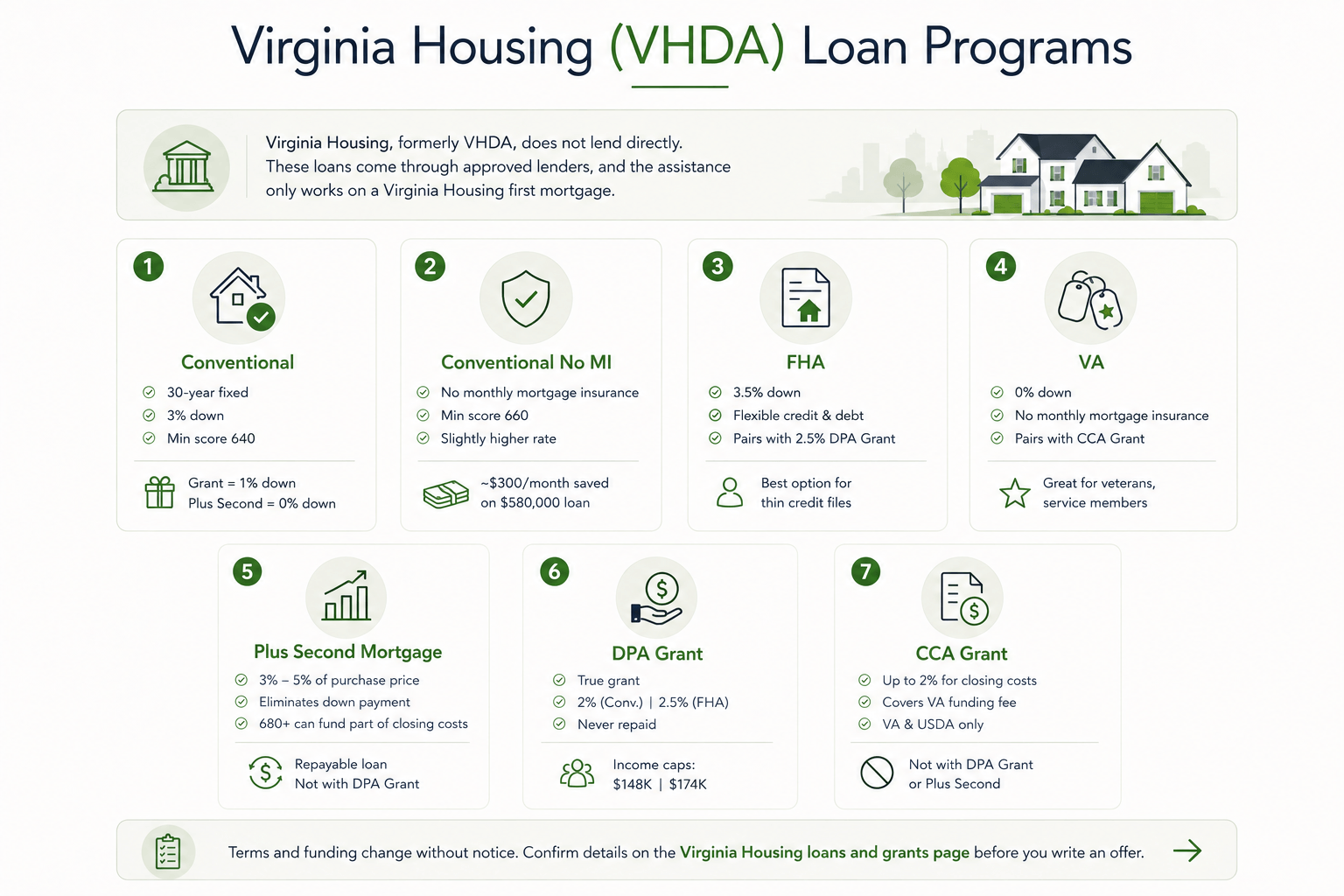
Virginia Housing, formerly VHDA, does not lend directly. These loans come through approved lenders, and the assistance only works on a Virginia Housing first mortgage.
Virginia Housing Conventional
A 30-year fixed at 3% down with reduced mortgage insurance, the real edge over a standard conventional 97. Minimum score 640. Add the grant and your down payment drops to 1%. Add the Plus Second Mortgage and it drops to zero.
Virginia Housing Conventional No MI
Same structure, no monthly mortgage insurance, worth roughly $300 a month on a $580,000 loan. The trade is a 660 credit bar and a slightly higher rate. On a long hold, no-MI usually wins.
Virginia Housing FHA
3.5% down with FHA’s more forgiving credit and debt standards, and the version that pairs with the 2.5% Down Payment Assistance Grant. For thin credit files, the most common path here.
Virginia Housing VA
Zero down for eligible veterans and service members, no monthly mortgage insurance, and it pairs with the Closing Cost Assistance Grant. In a region this heavy with military and federal households, it is the most underused combination on the list.
Virginia Housing Plus Second Mortgage
A second mortgage of 3% to 5% of the purchase price that eliminates the down payment, paired with an eligible first mortgage. Buyers at 680 or higher can finance part of their closing costs through it. It is repayable, not a grant, and cannot be combined with the DPA Grant.
Down Payment Assistance (DPA) Grant
A true grant: 2% of the purchase price on conventional, 2.5% on FHA, never repaid. On a $600,000 purchase that is $12,000 to $15,000 you do not have to save. Income caps run the tighter tier, $148,000 and $174,000.
Closing Cost Assistance (CCA) Grant
Up to 2% of the purchase price toward closing costs, and it exists to absorb the VA funding fee or USDA guarantee fee. VA and USDA first mortgages only. It cannot stack with the DPA Grant or the Plus Second Mortgage.
Terms and funding change without notice. Confirm details on the Virginia Housing loans and grants page before you write an offer.
Federal Loan Programs Virginia Buyers Use Most
Underneath every assistance program sits a first mortgage. Four cover almost every first-time buyer here.
FHA loans
3.5% down at a 580 credit score, 10% down between 500 and 579. The cost is mortgage insurance: 1.75% upfront financed into the loan, plus an annual premium that stays for the life of the loan at low down payments. The 2026 high-cost conforming ceiling is $1,249,125, per the Federal Housing Finance Agency, and Northern Virginia counties are treated as high cost. Confirm your county’s FHA figure with your lender.
VA loans
Zero down, no monthly mortgage insurance, competitive rates. The cost is the funding fee, roughly 1.25% to 3.3% depending on down payment and prior use. It is waived for veterans receiving compensation for a service-connected disability, and it can be financed or covered by the closing cost grant.
USDA Rural Development loans
Zero down with an income cap around 115% of area median income. The catch here is geography. Eligible areas sit in outer Loudoun, western Prince William, and Fauquier. Check the address on the USDA eligibility map first, because the boundaries move.
Conventional 97, HomeReady, and Home Possible
Three percent down conventional options. HomeReady and Home Possible add income limits, generally 80% of area median income, in exchange for cheaper mortgage insurance. Homebuyer education is required. The edge over FHA is real: private mortgage insurance comes off at 20% equity. FHA’s does not.
Mortgage Credit Certificate (MCC) in Virginia
This one comes with a correction. The Virginia Housing Mortgage Credit Certificate program has been suspended since May 1, 2023. No new certificates are being issued in 2026.
The last day a lender could lock a loan with an MCC was April 28, 2023, per Virginia Housing. Homeowners who got one before that date keep it for the life of the loan while they live in the home. Nobody buying today can get one.
I flag it because many Virginia buyer guides still list the MCC as an active benefit worth up to $2,000 a year. If a source tells you to budget for it, that source is out of date.
What still exists: mortgage interest and property taxes remain deductible if you itemize, and Virginia’s First-Time Homebuyer Savings Plan shelters investment earnings on money set aside for a first purchase from state income tax. Ask a tax professional before counting on either.
Local Down Payment Assistance in Northern Virginia
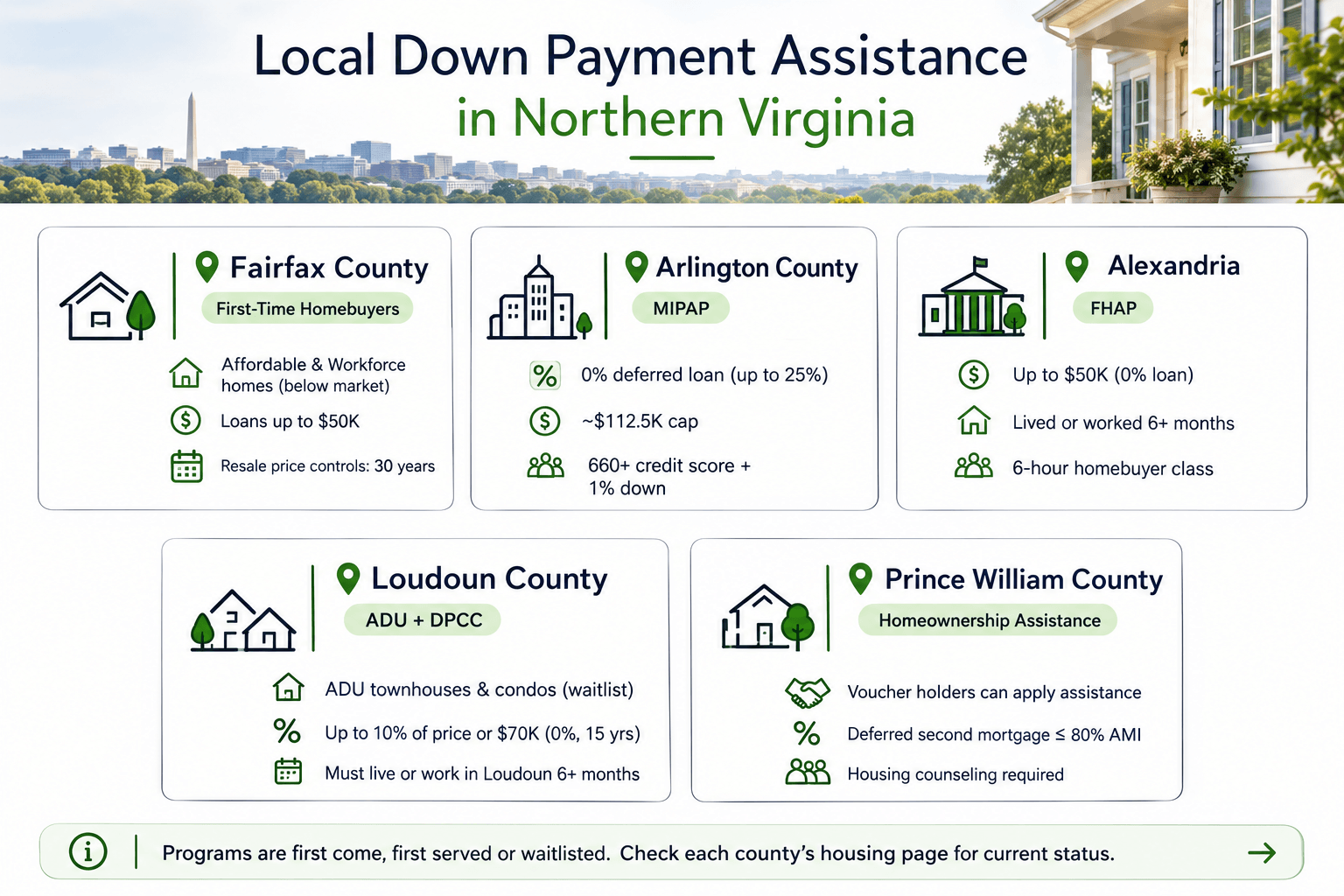
The largest dollars sit here, and so does the tightest funding. Each is first come, first served or waitlisted, and most require you to live or work in the jurisdiction.
Fairfax County First-Time Homebuyers Program
Fairfax sells Affordable Dwelling Units and Workforce Dwelling Units to income-qualified first-time buyers well below market, with resale price controls running 30 years. The Fairfax County Redevelopment and Housing Authority has also offered down payment loans up to $50,000 at or below 80% of area median income. Details on the county’s homeownership page.
Arlington County Moderate Income Purchase Assistance Program (MIPAP)
A 0% deferred second loan up to 25% of the purchase price, capped around $112,500, in exchange for a share of future equity. It requires a 660 score, a Virginia Housing conventional first mortgage, 1% from your own funds, and a homebuyer class. Review can take 60 days, and MIPAP opens and closes to new applications, so check status first.
Alexandria Flexible Homeownership Assistance Program (FHAP)
Up to $50,000 as a 0% deferred loan with a shared equity provision, for buyers who have lived or worked in Alexandria at least six months. Full assistance runs to roughly 80% of area median income, partial assistance above that. A six-hour homebuyer class is required.
Loudoun County ADU Purchase Program and DPCC loans
Two programs run together. The Affordable Dwelling Unit Purchase Program sells new and resale ADU townhouses and condos to eligible first-time buyers, currently by waitlist. The Down Payment and Closing Cost loan lends up to 10% of the sales price or $70,000, whichever is less, forgivable over 15 years at 0%. You must have lived or worked in Loudoun six months, and applications moved to the Neighborly platform in August 2026.
Prince William County homeownership assistance
A Housing Choice Voucher Homeownership program lets current voucher holders apply their assistance toward a purchase. The county also offers a deferred second mortgage at or below 80% of area median income for buyers who live or work in the county, Manassas, or Manassas Park. Housing counseling is required.
Grants and Employer Programs Often Missed
Three sources that rarely make the lists, and all three can stack with a Virginia Housing loan.
- Federal Home Loan Bank of Atlanta grants. Down payment and closing cost grants delivered through participating member lenders. Funding opens in rounds and products change annually. The question that matters is whether your lender is a member, so ask early.
- Good Neighbor Next Door. A HUD program offering 50% off the list price of HUD-owned homes in designated revitalization areas to teachers, law enforcement officers, firefighters, and EMTs, for a three-year occupancy commitment. Inventory is thin, but the discount is real.
- Employer-Assisted Housing. Hospital systems, universities, and some local governments offer forgivable loans or grants to employees buying near work. Most people never ask HR.
None of these replaces a first mortgage. They reduce the cash you bring, which is usually the binding constraint.
Real Cost Example: $600K Northern Virginia Purchase
Same house, same buyer, three financing paths at 6.65%, the Freddie Mac 30-year average as of August 20, 2026. Taxes, insurance, and association dues are excluded because they are identical in all three.
| Line item | FHA + VH DPA Grant | Conventional 97 + DPA | VA + CCA Grant |
|---|---|---|---|
| Down payment required | $21,000 (3.5%) | $18,000 (3%) | $0 |
| Grant applied | $15,000 (2.5%) | $12,000 (2%) | $12,000 toward funding fee |
| Cash for down payment | $6,000 | $6,000 | $0 |
| Upfront fee financed | $10,133 UFMIP | None | $900 funding fee balance |
| Loan amount | $589,133 | $582,000 | $600,900 |
| Principal and interest | $3,782 | $3,736 | $3,858 |
| Monthly mortgage insurance | $270 | About $315 | $0 |
| Monthly total | $4,052 | About $4,051 | $3,858 |
Assumes 6.65%, FHA annual mortgage insurance at 0.55%, conventional PMI at 0.65%, and a 2.15% VA funding fee for first use with no down payment. PMI pricing depends on credit score. Figures vary by lender and transaction.
Two things jump out. FHA and conventional land within a dollar of each other, so that choice comes down to credit score and whether you want the mortgage insurance to fall off later. And if you have VA eligibility, it is not close: roughly $195 a month cheaper, with nothing out of pocket.
Application Steps and Timeline
Six steps. Finish one through three before you tour anything, because homes here averaged 21 days on market in July 2026.
- Pre-qualify with a Virginia Housing approved lender. Not any lender. Assistance flows only through approved ones, and switching later restarts the file.
- Complete homebuyer education. The Virginia Housing course is free and online. Some counties require their own six-hour class, so check first.
- Apply for local assistance. County programs run on their own calendars and can take 60 days. Start before you shop, not after you ratify.
- Shop inside your real number. Caps matter. Virginia Housing’s is $800,000 here. Arlington’s MIPAP caps around $500,000.
- Ratify and underwrite. Expect a longer timeline than a standard conventional file. Assistance layers add reviewers.
- Close. Grants are applied at settlement. You never touch the money, and you never repay it.
Common First-Time Buyer Mistakes in Virginia
Four mistakes account for most of the money left on the table with first time home buyer programs Virginia buyers already qualify for.
- Skipping state programs to move faster. Assistance adds days to underwriting. Sellers care about certainty and settlement date, and both are solvable. Giving up $15,000 to save a week is a bad trade.
- Assuming FHA is always cheapest. For a VA-eligible buyer it almost never is. Look at the table above.
- Assuming you earn too much. The grant limit here is $148,000 for two people and $174,000 for three or more. Bond programs go to $186,000 and $217,000. Dual-income buyers screen themselves out constantly.
- Never checking the Area of Economic Opportunity map. It is a census tract test with looser limits, and almost nobody asks their lender to run the address.
Your next step
Programs are half the answer. The other half is what your money buys on the street you actually want.
Start here: Buy a Home. Tell us your timeline, target areas, and household size, and we will map the first time home buyer programs Virginia gives you against real listings. No pressure and no obligation.
FAQs
What are the best first time home buyer programs Virginia offers in 2026?
For most buyers, a Virginia Housing first mortgage paired with the Down Payment Assistance Grant: 2% of the purchase price on conventional, 2.5% on FHA, never repaid. VA-eligible buyers should use a VA loan with the Closing Cost Assistance Grant instead. Also apply to your county program, where Loudoun lends up to $70,000 and Alexandria up to $50,000.
Do you have to be a first-time buyer to use Virginia Housing loans?
Not always. The Plus Second Mortgage is open to repeat buyers, and the requirement is waived in designated Areas of Economic Opportunity. The grants do require first-time status outside those areas.
What is the minimum credit score for an FHA loan in Virginia in 2026?
FHA allows 3.5% down at 580, and 10% down between 500 and 579. Lenders often set a higher floor, commonly 620, and Virginia Housing layers its own minimums on top.
Can you combine the Virginia Housing DPA Grant with a VA loan?
No. The Down Payment Assistance Grant pairs with Virginia Housing conventional and FHA first mortgages. VA and USDA borrowers use the Closing Cost Assistance Grant, up to 2% of the purchase price, usually applied to the funding fee.
What are the Virginia Housing income limits in Fairfax County?
Fairfax sits in the Washington, Arlington, Alexandria area. Effective August 1, 2026, grant programs cap income at $148,000 for two or fewer people and $174,000 for three or more. Bond programs go to $186,000 and $217,000, with a $800,000 sales price limit on both.
Is homebuyer education required for an FHA loan in Virginia?
Not by FHA itself. It is required for Virginia Housing loans and grants, for HomeReady and Home Possible, and for most county programs. Plan on taking it.

About Michael Gorman
Michael Gorman is the founder and Principal Broker of RealtyPeople, a full-service brokerage serving Northern Virginia. He holds a Harvard MBA, has 24+ years in the business, 2,000+ transactions closed, and more than $2 billion in volume. He is an NVAR Diamond Top Producer for 10+ consecutive years and a former Senior Vice President at Long & Foster. Mike runs every file personally, start to finish.
View profile →Compliance and disclosures: Equal Housing Opportunity. Licensed real estate brokerage in the Commonwealth of Virginia. This guide is general information, not lending, tax, or legal advice. Program terms, income limits, and funding availability change without notice. Verify current figures with an approved lender and the program administrator before you rely on them.
