
A 1% fee tells you the price. The written agreement tells you what you get.
If you are comparing a 1% listing commission Virginia offer with a traditional listing, the percentage is the easy part. The hard part is knowing exactly which tasks, people, and deadlines that fee buys.
I have spent 24+ years in Northern Virginia real estate and closed 2,000+ transactions. This guide stays on deliverables: what to ask for, what to get in writing, and how to check it. For the savings math, start with our analysis of whether a 1% commission realtor is worth it. For the bigger picture, see our guide to a low commission realtor in Northern Virginia.
1% listing commission Virginia: what does the advertised fee cover?
A 1% fee describes the listing-side rate only. Services vary by agreement, and your total cost to sell includes more than the commission. Two agents can both charge 1% and deliver very different work.
So when you ask what does a 1% listing commission include, the honest answer is: whatever the written agreement says. Virginia law requires every brokerage agreement to state the services the agent will provide, the fee, and how and when it is paid (Va. Code § 54.1-2137, 2026).
Published lists help you compare. For example, RealtyPeople’s published seller package lists six items. They are MLS and 100+ real estate sites, a yard sign and lockbox, listing setup and showings, offer review and negotiation, contract-to-close support, and weekly feedback updates (published package, 2026). Whatever list you see, make sure the same items appear in the agreement you sign.
Illustrative example: a $1 million McLean sale
Illustrative example. Numbers are rounded and hypothetical.
Say you sell a McLean home for $1,000,000. At 1%, the listing commission is $10,000. RealtyPeople publishes a $500 + 1% model for sellers (published package, 2026). Its published terms say the $500 is paid upfront and the 1% is paid at closing only if and when your home sells (low commission guide). So its listing charge on that sale is $10,500. If you searched “1% commission realtor McLean,” this is the first math to ask any agent for.
That $10,500 is the listing side only. Keep three other numbers separate:
- Buyer-agent compensation. Any payment toward the buyer’s agent is a separate, negotiated decision. It is no longer offered through the MLS, and sellers can still offer it off the MLS (NAR, 2024).
- Other closing expenses. Settlement fees, taxes, payoff costs, and any repair credits come out of your proceeds too. Here is a breakdown of the cost to sell a home in Northern Virginia.
- Negotiability. Broker fees and commissions are fully negotiable and not set by law (NAR, 2024).
Any 1% commission realtor in McLean should be able to show you, in one page, how the listing fee, any buyer-side offer, and closing costs add up. When you evaluate any $500 plus 1% commission real estate offer, ask for that same one-page view. If a 1% listing commission Virginia offer cannot be explained that simply, keep asking.
Which deliverables should sellers receive before launch?
Turn “full service” into written tasks, named people, deadlines, and proof.
Virginia requires the agreement to list the services and the payment terms. The specific marketing work, like how many photos or which websites, depends on what you and the agent agree to in writing (Va. Code § 54.1-2137, 2026). Use this table as your audit.
| Deliverable | Included? | Extra charge? | Seller responsibility | Proof delivered |
|---|---|---|---|---|
| Comparable-sales analysis | Confirm in writing. | Ask. | Share upgrades and repairs. | Written comps with adjustments. |
| Pricing recommendation | Confirm in writing. | Ask. | Decide on the list price. | A price range with reasons. |
| Photography | Confirm who shoots and how many photos. | Ask about video, drone, or floor plans. | Home clean and ready on shoot day. | Photo gallery before launch. |
| MLS accuracy | Confirm who enters and checks the listing. | Ask. | Review facts: rooms, square footage, HOA. | A draft listing you approve. |
| Showing coordination | Confirm the scheduling system. | Ask. | Keep the home show-ready. | Showing log or app access. |
| Feedback reports | Confirm how often. | Ask. | Read and respond. | Weekly written summary. |
| Negotiation | Confirm who negotiates. | Ask. | Make final decisions. | Written offer comparisons. |
| Settlement support | Confirm who tracks deadlines. | Ask. | Sign documents on time. | A contract-to-close timeline. |
Fill in every cell before you sign. A blank cell is a question the agent has not answered yet.
How to run the audit in a listing interview
Bring the table to every interview. Ask each agent the same questions, in the same order, so the answers are easy to compare.
- Who does it? Ask for the name of the person who owns each task.
- When does it happen? Ask for a date relative to launch, such as photos five days before going live.
- What do I see? Ask for a sample of the proof: a past pricing report, a feedback summary, or a contract-to-close timeline.
Watch for vague answers. “We take care of everything” sounds reassuring, but it gives you nothing to check later. Specific answers are what separate a full-service agreement from a slogan.
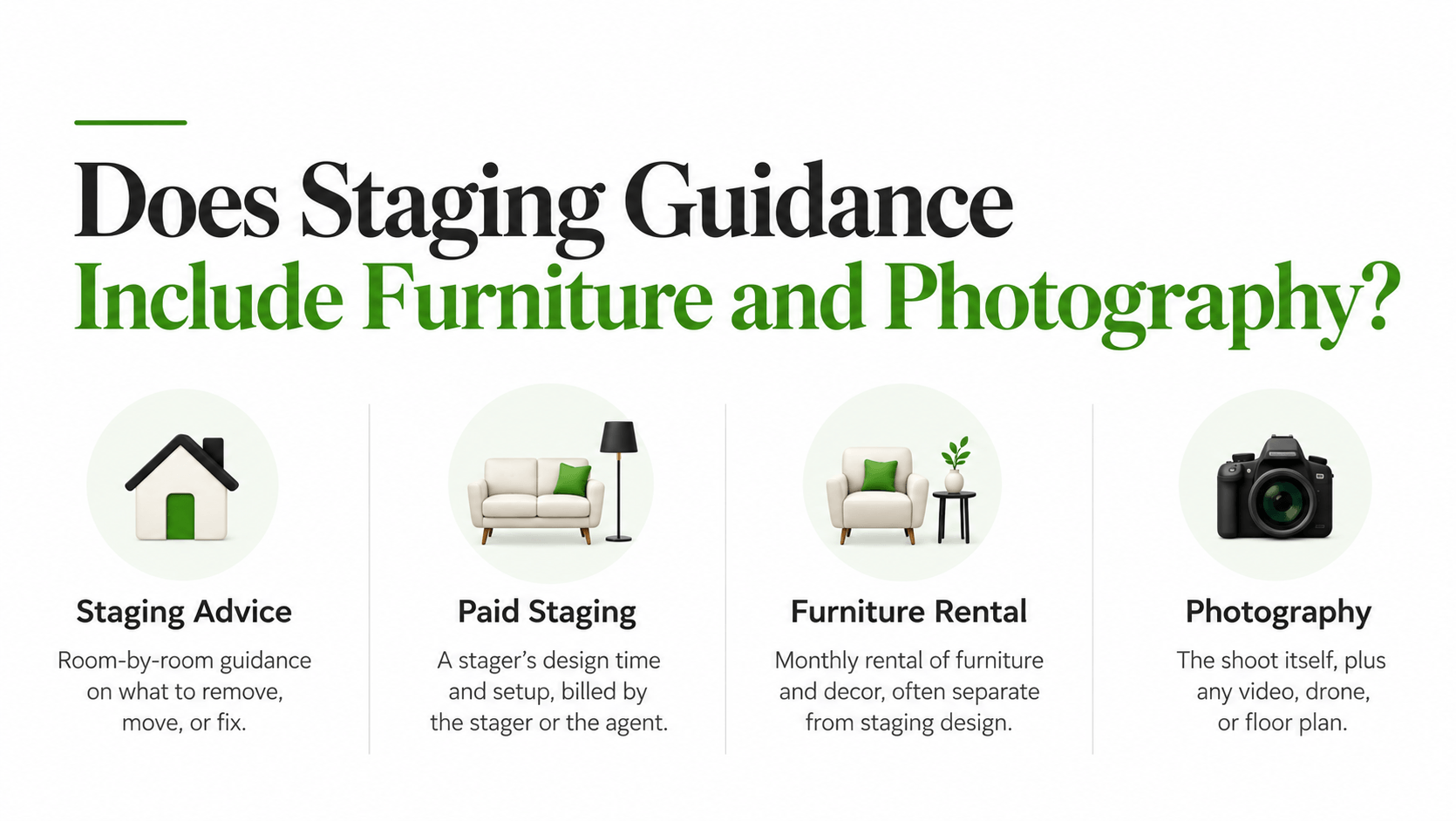
Does staging guidance include furniture and photography?
Usually these are four different things. Staging advice, paid staging, furniture rental, and photography can each be included, extra, or not offered. Get each one itemized.
- Staging advice. Room-by-room guidance on what to remove, move, or fix.
- Paid staging. A stager’s design time and setup, billed by the stager or the agent.
- Furniture rental. Monthly rental of furniture and decor, often separate from staging design.
- Photography. The shoot itself, plus any video, drone, or floor plan.
The right mix depends on the home. Ask for an itemized answer for your property, marked included, extra, or not offered.
Occupied Fairfax townhouse. Ask about each line:
- Staging advice: a room-by-room walk-through before photos.
- Paid staging: often unnecessary if your own furniture works. Ask the price if it is offered.
- Furniture rental: usually not needed. Confirm it is not billed by default.
- Photography: who shoots, how many photos, and whether a floor plan is included.
Vacant McLean house. Ask about each line:
- Staging advice: which rooms to furnish first.
- Paid staging: the stager’s fee and who hires them.
- Furniture rental: monthly cost, minimum term, and who pays if the house takes longer to sell.
- Photography: whether photos happen after staging, and whether video or twilight shots cost extra.
Staging can matter. In NAR’s 2025 staging report, 83% of buyers’ agents said staging made it easier for a buyer to visualize the property as a future home. The rooms staged most often were the living room (91%), primary bedroom (83%), and dining room (69%) (NAR, 2025).
That finding does not promise a higher price, and it tells you nothing about what your package includes. With any 1% listing commission Virginia agreement, the only way to know is to see staging and photography itemized in writing.
Who handles negotiations and problems after an offer?
Confirm who advises you, who negotiates, who tracks deadlines, and who coordinates settlement. An agent who only forwards documents leaves the hard part to you.
Many problems show up after you accept an offer. Ask who handles each of these:
- Inspection credits. Who reviews the buyer’s repair requests and drafts your response?
- Appraisal shortfalls. Who explains your options if the appraisal comes in below the price?
- Financing delays. Who follows up with the buyer’s lender and tracks contract deadlines?
- HOA documents. Who orders the resale certificate and makes sure it is delivered on time?
- Backup coverage. Who steps in if your agent is sick or on vacation during a deadline?
Ask for the contract-to-close timeline the agent will use on your sale. It should list each deadline, who owns it, and how you will be told when it is met.
Virginia law draws the line here. A standard agent representing a seller must help draft and negotiate offers, counteroffers, and addenda. The agent must also present offers in a timely way and help the seller meet contract obligations and reach settlement (Va. Code § 54.1-2131, 2026).
A limited service agent can leave out one or more of those duties. If so, the agreement must say the agent is acting as a limited service agent. It must also list the services it will provide and the standard duties it will not, in a conspicuous format (Va. Code § 54.1-2138.1, 2026; § 54.1-2130, 2026).
Illustrative example: how I handle an appraisal gap
Illustrative example based on my standard process. It describes no single client’s transaction and shows no savings figure.
I’m Michael Gorman, principal broker and Harvard MBA. Here is how I typically work through one common problem.
- The issue. The buyer’s appraisal comes in below the contract price, days before a contract deadline.
- The action. I review the appraisal and the contract terms, lay out the seller’s options in writing, and open the conversation with the buyer’s agent before the deadline passes.
- The outcome. The seller makes the decision with the facts in front of them, before the deadline. The dollar result depends on the deal, so I do not promise one.

What should you confirm before signing?
The written scope and exit terms matter more than the headline percentage. Read them before you compare fees.
Virginia requires a definite termination date. If the agreement leaves it out, it ends 90 days after the date of the agreement. It must also state the services and the fees, and how and when they are paid (Va. Code § 54.1-2137, 2026). Use this checklist:
- Minimum fee. Is there a floor, regardless of sale price?
- Upfront fee. When is it paid, and is any part refundable?
- Extras. Which services cost more, and what is the price for each?
- Cancellation procedure. How do you end the agreement, and does ending it early cost anything?
- Expiration. What is the exact end date?
- Post-termination compensation. Do you owe a fee if a buyer the agent introduced buys after the agreement ends? Virginia law does not set this. It is a contract term, so read it.
- Unrepresented-buyer charges. Does the fee change if the buyer has no agent?
If you are choosing between two agents, put their agreements side by side and compare these seven lines first. Two offers with the same percentage can look very different once the upfront fee, extras, and exit terms are written out.
After the agreement ends, the agent generally owes no further duties except to account for money and keep your information confidential, unless you agreed otherwise in writing (Va. Code § 54.1-2137, 2026).
A strong 1% listing commission Virginia agreement answers every item on that list in plain writing. If it does not, ask before you sign.
Frequently asked questions
Does 1% listing commission Virginia include buyer-agent compensation?
Usually no. The 1% covers the listing side. Any payment to the buyer’s agent is a separate, negotiated term, and it is no longer offered through the MLS.
Are professional photos automatically included?
Only if your agreement says so. Check the written list of services for who shoots, how many photos, and whether video or floor plans cost extra.
Is a lower fee legally “limited service”?
Price does not decide it. In Virginia, an agent is a limited service agent if the agreement excludes one or more standard duties. The agreement must then disclose that conspicuously.
Is winter ever a good time to list in Northern Virginia?
Yes, when inventory is scarce. Even January 2026 ran at just 1.10 months of supply. Fewer buyers are shopping, but the ones who are shopping in January are serious, and your listing is one of a few instead of one of many.
Start with an accurate number for your home.
Every question in this guide is easier once you know what your home is likely worth. That number shows you what 1% actually means in dollars, before you compare agreements.
Request your Free Home Valuation Report. It comes with no obligation.

About Michael Gorman
Michael Gorman is the founder and Principal Broker of RealtyPeople in McLean, Virginia. He holds an MBA from Harvard Business School, has closed more than 2,000 transactions and $2 billion in volume over 24+ years in Northern Virginia, and has been an NVAR Top Producer at the Diamond level for 10+ consecutive years. Before founding the brokerage, he was Senior Vice President of Business Development at Long & Foster.
View profile →Compliance and disclosures: Equal Housing Opportunity. Licensed real estate brokerage in the Commonwealth of Virginia. This guide is general information, not legal, tax, or financial advice. Market data changes monthly. Verify current figures before you rely on them.
