
Most families who search for the best schools in Northern Virginia start with a ranking. A ranking is a fair place to start and a poor place to stop. The school that matters is the one your child can attend from the address you buy.
That gap between a ranked school and an assigned school is where home buyers get hurt. Some top-ranked schools admit by application or lottery. Boundaries move. A mailing address can point to the wrong school division.
Michael Gorman, our founder and Principal Broker, has closed 2,000+ transactions across Northern Virginia since 2001. Many of those buyers chose a home with a specific school in mind. The ones who avoided surprises checked the address before they wrote the offer.
This guide shows you how to define “best” for your family, how the region’s school divisions are organized, which ranked schools admit by address, and how to verify a home’s school assignment. Every figure below carries a date. Rankings and boundaries cited here were checked in November 2026.
Best schools in Northern Virginia: Selection criteria
The best school for your family is one that matches your child’s learning needs, shows strong student growth, offers the programs you want, and is confirmed to serve your address. A rank on a list answers only part of that.
Two kinds of sources describe school performance. Government accountability data comes from the state. Publisher rankings come from media companies. They measure different things, so keep them on separate lines.
What Virginia measures
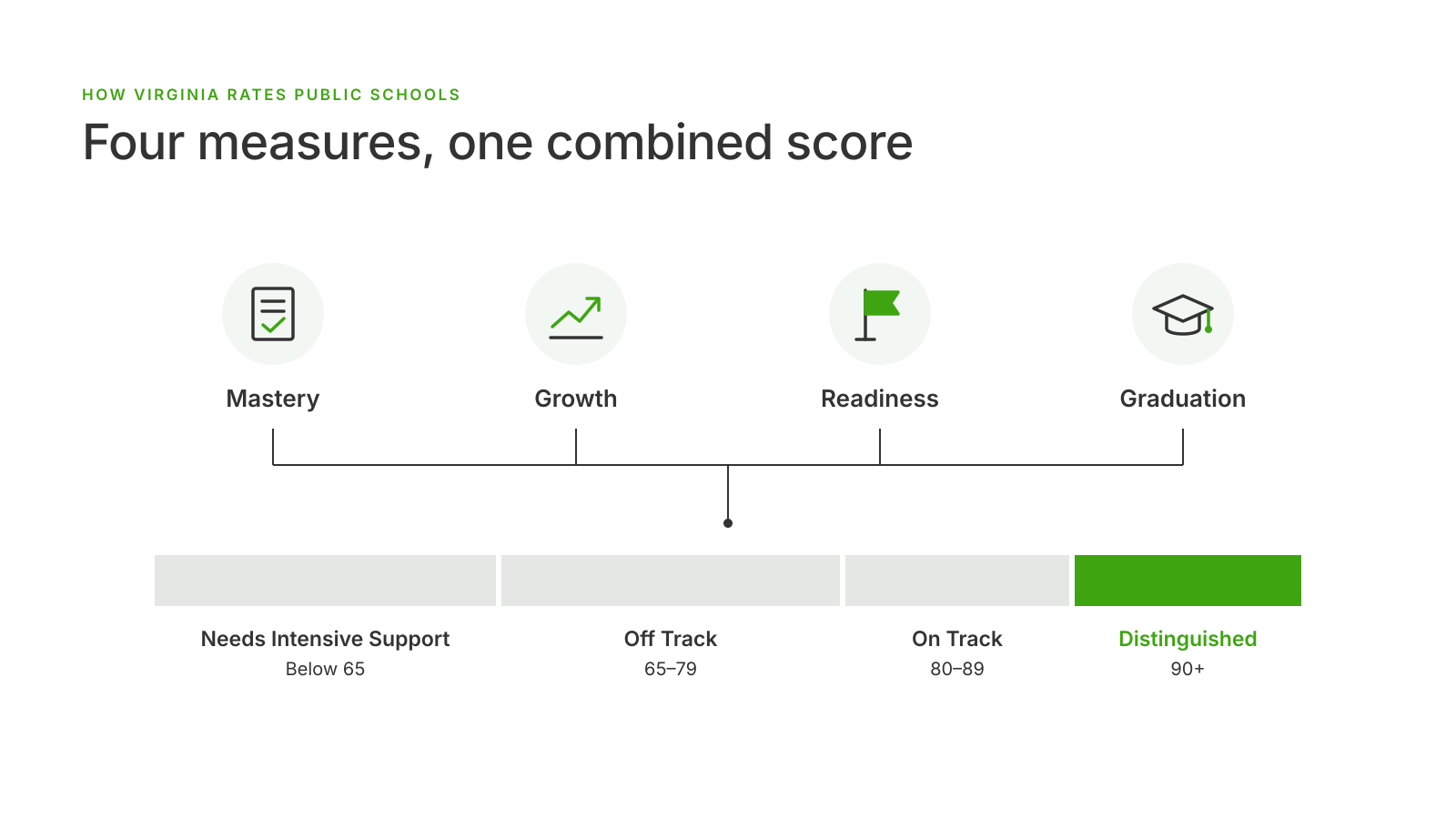
Virginia rates public schools under its School Performance and Support Framework. The Virginia Department of Education scores schools in up to four areas:
- Mastery. Results on Standards of Learning tests for all students, with extra credit for advanced scores.
- Growth. How much each student learned during the year, compared with what past scores predicted.
- Readiness. Measures such as chronic absenteeism, advanced coursework in middle school, and how prepared graduates are for college, work, or military service.
- Graduation. The four-year graduation rate for high schools.
Schools land in one of four categories based on combined points: Distinguished at 90 or more, On Track at 80 to 89, Off Track at 65 to 79, and Needs Intensive Support below 65.
Growth deserves a close look. A mastery score tells you where students finished. A growth score tells you how far the school moved them. For a child who is behind or far ahead, growth is often the more useful number.
The framework labels no school as failing. Lower categories trigger added state support, so read a category as a signal to ask questions and look deeper.
What publisher rankings measure
Publisher rankings are narrower. The U.S. News elementary and middle school rankings rest on state math and reading test results. Its high school rankings add graduation rates and college readiness measures.
Rankings also shift from year to year. Thomas Jefferson High School for Science and Technology ranked No. 5 nationally in the prior U.S. News edition and No. 6 in the 2026-2027 edition.
The school stayed the same. The list moved.
Use a ranking to build a list of schools to research. Use state data and a school visit to decide.
Four filters for your family
Run every school on your list through these four filters:
- Learning needs. Advanced academics, special education services, language support, or a smaller setting. Ask each school how it serves a child like yours.
- Growth. Look at the state growth data for the grades your child will attend.
- Programs. Language immersion, International Baccalaureate, Advanced Placement, arts, STEM, or career and technical courses. Programs vary school by school inside one division.
- Verified assignment. Written confirmation that the home’s address is served by the school for the year your child enrolls.
What to ask on a school visit
Data narrows the list. A visit tests it. Bring the same questions to every school so the answers line up:
- How does the school identify and serve advanced learners, and at which grade does that start.
- What support is in place for a child who needs help in reading or math.
- Which programs are offered on site, and which require a transfer to another school.
- How many students per class in your child’s grade this year.
- Whether any boundary or program changes are planned for the school.
Families who rank the best schools in Northern Virginia by test scores alone often skip this step. The visit is where you learn whether the school suits your child.
Put a date next to each number you collect. A 2025 test score and a 2027 ranking describe different school years.
Northern Virginia school districts
Compare individual schools, and treat the division as background. A division-wide average blends dozens of schools, and it hides the differences between two schools a few miles apart.
Virginia calls its districts school divisions, and each one follows a county or independent city line. Northern Virginia school districts break down this way:
- Fairfax County Public Schools. The largest division in the region. It serves Fairfax County and the City of Fairfax, including McLean, Vienna, Oakton, Great Falls, Reston, Herndon, Burke, Springfield, and Centreville.
- Loudoun County Public Schools. Serves Ashburn, Sterling, Leesburg, Aldie, and the rest of Loudoun County.
- Arlington Public Schools. Serves Arlington County.
- Falls Church City Public Schools. A small division that serves only addresses inside the City of Falls Church limits.
- Alexandria City Public Schools. Serves the City of Alexandria. Many homes with an Alexandria mailing address sit in Fairfax County and attend Fairfax County schools.
- Prince William County Public Schools. Serves Woodbridge, Dumfries, Occoquan, and the rest of the county. It runs specialty programs and two traditional schools that admit by application.
- Manassas City Public Schools and Manassas Park City Schools. Two separate city divisions, each with its own boundaries.
The division line follows the jurisdiction, and the mailing address can mislead you. A Falls Church, Alexandria, or Fairfax mailing address can belong to more than one jurisdiction. Always confirm the county or city on the tax record.
The jurisdiction also sets your property tax rate and your local services, so the county or city line shapes the monthly cost of the home as well as the school.
Programs that cross boundaries
Every division runs some programs that draw students from beyond a single attendance zone. Examples include advanced academic centers, language immersion, International Baccalaureate, and specialty or magnet schools.
The rules differ by division and by program. Some admit by application. Some use a lottery. Some assign a site based on your base school.
Transportation is offered for certain programs and left to parents for others.
Ask the division three things about any program you care about: who is eligible, how seats are filled, and whether a seat carries through to the next school level.
How to compare schools on equal terms
The state publishes a profile for every public school at the Virginia School Quality Profiles site. Each profile covers student achievement, readiness, attendance, teacher quality, and school safety. Follow these steps for a fair comparison:
- Pull the profile for each specific school, at each level your child will attend.
- Match the reporting year. Compare 2025-26 data with 2025-26 data.
- Match the grade span. An elementary school that ends at grade 5 and one that ends at grade 6 report different test sets.
- Compare the same measures: mastery, growth, and attendance side by side.
- Note the school’s size and the programs it hosts, since both shape the numbers.
Then visit. A profile shows results. A tour, a talk with the principal, and a conversation with current parents show how the school runs day to day.
If you are moving from outside the region, our guide to moving to Northern Virginia covers commutes and communities across these same jurisdictions.
Elementary and middle school examples
Two of the highest-ranked schools in the region show why eligibility matters more than rank. One enrolls mainly by home address. The other enrolls only by application and lottery.
In October 2026, Northern Virginia Magazine reported the 2027 U.S. News rankings for Virginia. Eight of the state’s top 10 elementary schools and six of its top 10 middle schools are in Northern Virginia.
Haycock Elementary: attendance by address
Haycock Elementary ranked No. 2 among Virginia elementary schools in the 2027 U.S. News list. It is a Fairfax County public school with an attendance boundary, and it also hosts an Advanced Academic Program center.
Students reach Haycock in two ways. Most live inside its boundary. Others qualify for full-time advanced academic services and are assigned to the center from nearby schools.
Fairfax County delivers full-time advanced academic services in two models: a local program inside the base school, or a center that draws from several schools. Which model serves an address is part of the boundary answer.
Haycock also teaches a geography lesson. Its mailing address reads Falls Church, yet it belongs to Fairfax County Public Schools. The name on the envelope says little about the school division.
Other Fairfax County schools in the same top 10 include Sangster Elementary in Springfield at No. 4, Churchill Road Elementary in McLean at No. 5, and Colvin Run Elementary at No. 7.
Mary G. Porter Traditional: attendance by application
Mary G. Porter Traditional School in Woodbridge ranked No. 2 among Virginia middle schools in the same list. It is a Prince William County specialty school that serves grades 1 through 8.
Living next door earns you nothing here. Every student transfers in through the Porter application process. Families must live in the designated area of eastern Prince William County and apply by the deadline. When applications exceed open seats, the school runs a lottery.
The school reports that siblings of current students receive preference, and Prince William County offers express bus stops for accepted students who live outside the school’s immediate area.
Pennington Traditional School in Manassas, ranked No. 3, works the same way for the western half of the county.
One caution on both examples. These rankings rest on state reading and math results, and a school that selects or attracts a particular group of students will reflect that in its scores. A high rank describes outcomes. It leaves open how a school would serve your own child.
Three ways students get a seat
Before you tie a home search to any school, find out which path applies:
- Boundary assignment. Your address decides the school. This is the path a home purchase can control.
- Application or lottery. Residency in the division or a zone makes you eligible. Admission depends on the application and on chance.
- Program placement. A child qualifies for a program, such as advanced academics, and the division assigns the site.
A home purchase secures the first path only. For the other two, a house gives you eligibility and the school decides the rest.
Top high schools Northern Virginia
The region’s highest-ranked high school admits by competitive application, so a nearby address offers no advantage. For most families, the assigned neighborhood high school is the one to research.
Thomas Jefferson High School for Science and Technology
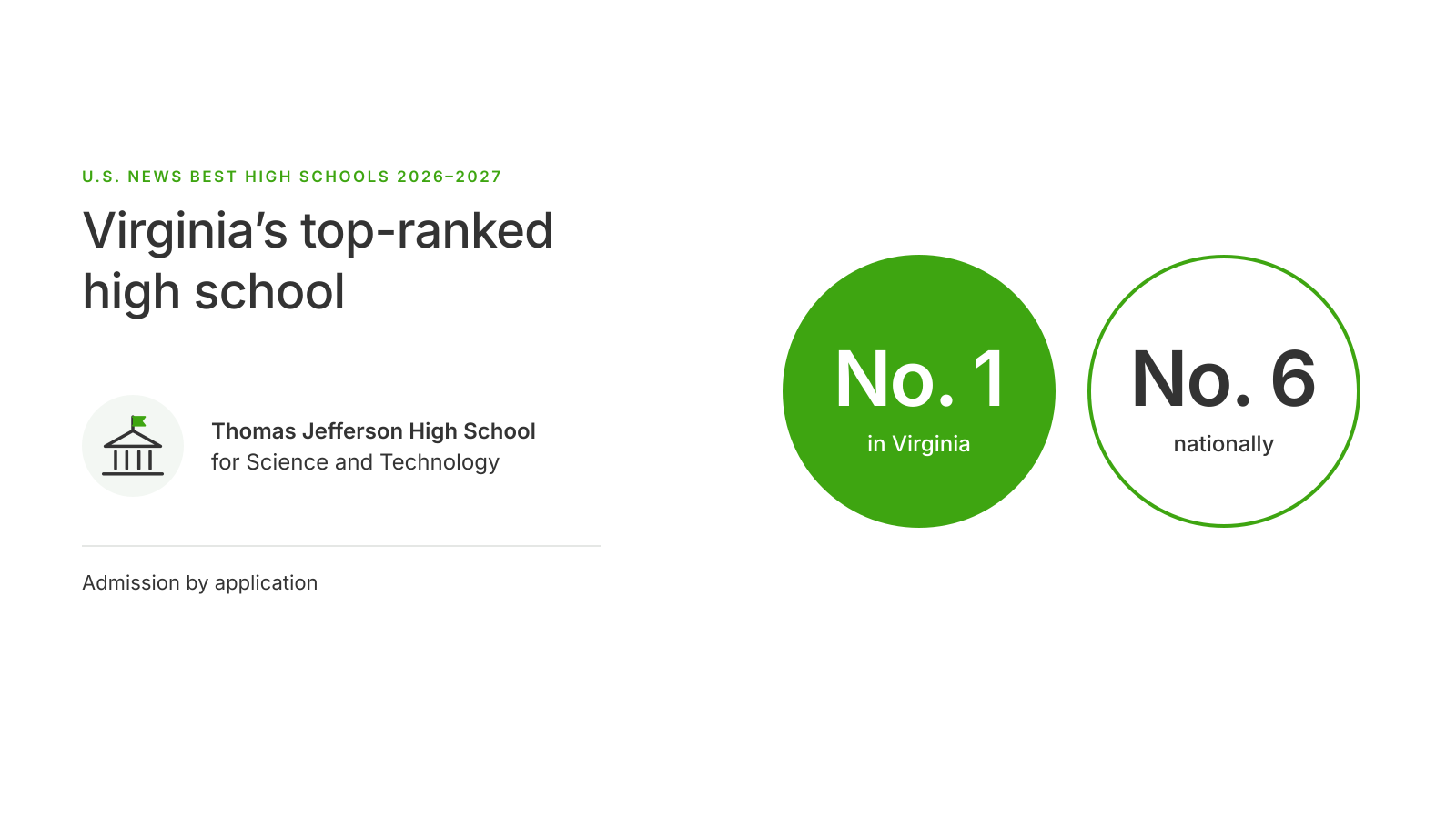
Thomas Jefferson High School for Science and Technology, known as TJ, ranked No. 6 nationally and No. 1 in Virginia in the 2026-2027 U.S. News Best High Schools rankings, published in August 2026.
TJ is a Virginia Governor’s School for grades 9 through 12, run by Fairfax County Public Schools. Its campus has an Alexandria mailing address and sits in Fairfax County.
Admission runs through an application in eighth grade. The FCPS eligibility rules require residency in a participating division:
- Fairfax County, including the City of Fairfax
- Arlington County
- Loudoun County
- Prince William County
- Falls Church City
Students who live in the cities of Alexandria, Manassas, and Manassas Park are outside the program. Those divisions have opted out.
Applicants also need set coursework and grades. FCPS lists Honors Algebra 1 or higher in eighth grade, honors science, one more honors course, and a 3.5 grade point average in core classes. The review itself is holistic.
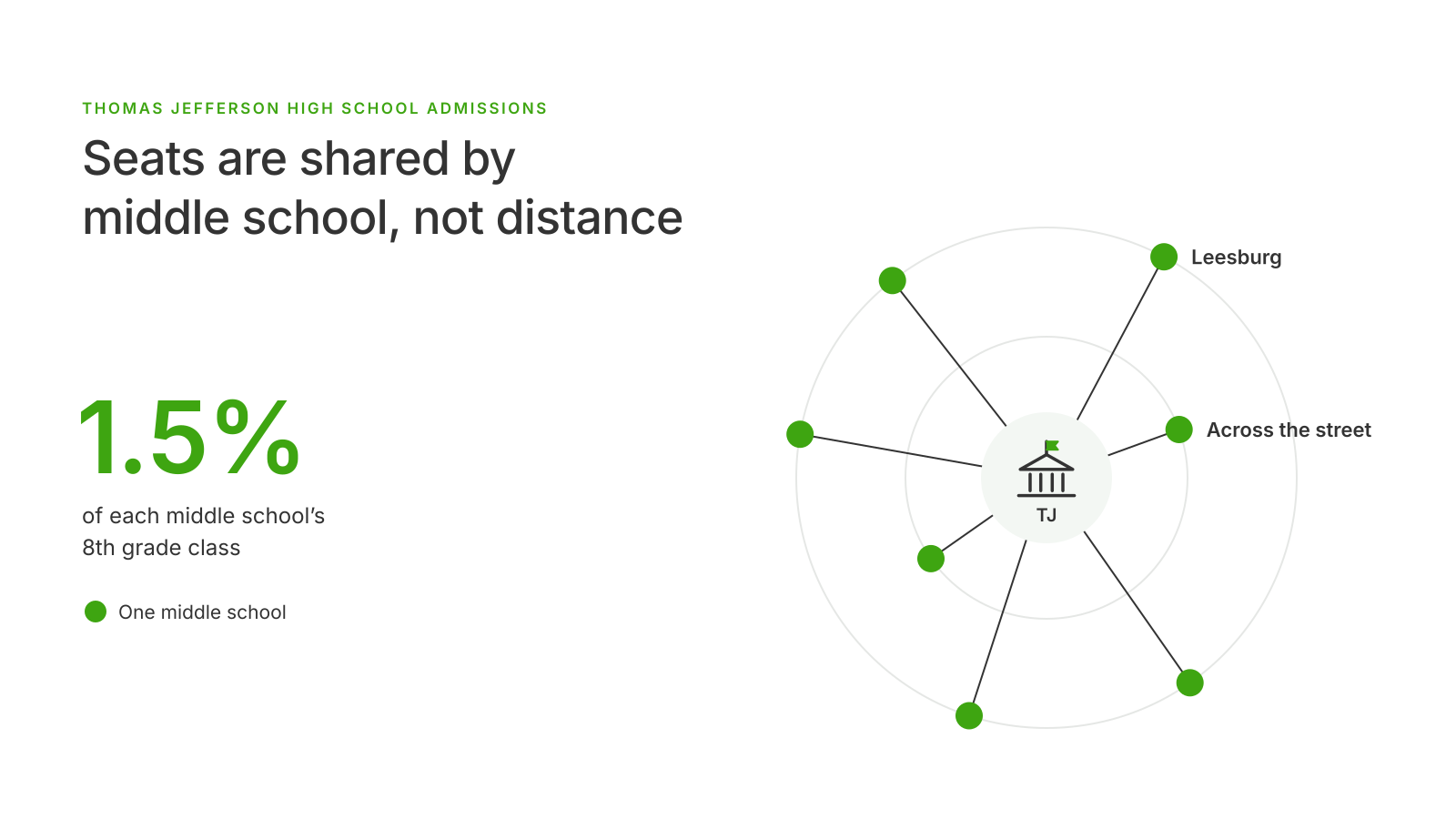
Seats are spread across the region. Each public middle school in a participating division is allocated seats equal to 1.5% of its eighth grade class.
That allocation is why location near the campus carries no weight. A student in Leesburg and a student who lives across the street from TJ compete through the same process.
A limited number of students also enter in tenth and eleventh grade through a separate spring application.
If TJ is a goal, a home purchase can help in two modest ways. It can place you in a participating division, and it can place your child in a middle school that offers the required honors courses. Admission itself stays with the application.
Researching your assigned high school
Lists of top high schools mix application schools with neighborhood schools. Once you set TJ aside, your address decides the high school in most of the region.
Check these items on the state profile for each assigned high school:
- The four-year graduation rate.
- The readiness measures for graduates.
- Advanced course options, such as Advanced Placement, International Baccalaureate, or dual enrollment.
- Career and technical programs, if those matter to your child.
Advanced courses come in three main forms, and high schools differ in which ones they offer:
- Advanced Placement. Single college-level courses, each ending in a national exam. Students pick the subjects they want.
- International Baccalaureate. A linked two-year program with its own exams and a diploma option. Students can also take single courses.
- Dual enrollment. College courses taken during high school, with credit from a partner college.
Each one suits a different kind of student. Ask the school which it offers, how many students take part, and how they perform on the exams.
Look at the middle school that feeds it too. Children change schools twice before graduation, and both transitions belong in your plan.
Fairfax County school district map
Verify the specific address and the enrollment year before you write an offer. The Fairfax County school district map changed for 2026-27, and more changes are under study.
In January 2026, the Fairfax County School Board approved boundary changes after the division’s first full boundary review in about 40 years. FCPS reported that the changes affect about 1,700 students at 46 schools and take effect in the 2026-27 school year. Details are on the FCPS school boundary adjustments page.
Three points matter for a home buyer:
- Phasing. The changes roll in under School Board Policy 8130, which phases assignments by school level and grade. A rising kindergartner and a current fifth grader at the same address can receive different answers.
- Future changes. FCPS has more boundary studies underway, with recommendations due to the School Board by January 2027. An address that is settled today may be inside a study area.
- Written district confirmation. Ask the school or the FCPS boundary office to confirm the assignment for your child’s grade and enrollment year in writing. Keep the reply with your purchase file.
A useful confirmation names four things: the street address, the assigned school at each level, the school year it covers, and the grade of your child. An answer that leaves one out is incomplete.
How to check an address
The FCPS Boundary Locator identifies the elementary, middle, and high schools that serve an address, along with the Advanced Academic Program centers for elementary and middle school.
Use it in this order:
- Enter the full street address of the home. Skip the neighborhood name and the zip code as shortcuts.
- Confirm which school year the result covers.
- Compare the result with the adopted 2026-27 boundaries on the FCPS boundary page.
- Ask whether the address falls inside any current boundary study.
- Request written confirmation for your child’s grade.
Run the check for every home you tour seriously, and repeat it before you sign. Two houses on the same street can sit on opposite sides of a line, and a boundary can split a subdivision.
Ask about feeder patterns too. An elementary school can send its students to more than one middle school, and a middle school to more than one high school. Confirm all three levels for the exact address.
Treat the school names in a home listing as a lead to check. Listing data is entered by hand and can lag behind a boundary vote.
FCPS states that boundaries may be adjusted by the School Board and gives no assurance that an address will stay with the same schools. Plan for that. The same habit applies in every division: Loudoun, Arlington, and Prince William each publish their own address lookup, and each can redraw lines.
Do this work before the offer. After you ratify a contract, a school surprise is your problem to solve, and your options narrow fast.
Housing choices alongside school needs
Balance four things: the programs your child needs, the space your family needs, the commute, and the total cost of owning the home. A school answers one of the four.
The best schools in Northern Virginia sit in areas with different housing stock, commutes, and price points. Two homes at the same price can deliver two different daily lives.
Michael Gorman is a Virginia Principal Broker and Harvard MBA with 24+ years in Northern Virginia real estate and 2,000+ transactions. The pattern across move-up purchases is consistent: the families who feel good about the decision years later weighed all four on paper, with real numbers.
The four-part comparison
- Programs. List the specific programs and services each assigned school offers at each level, and confirm them with the school.
- Space. Bedrooms, a home office, the yard, and room to grow. Compare what the same budget buys in each area.
- Commute. Drive or ride the route at rush hour, to work and to school. Add tolls, parking, and Metro fares to the monthly budget.
- Total ownership cost. Mortgage payment, property taxes, HOA dues, insurance, utilities, and upkeep. Older homes and newer homes carry different repair timelines.
Vienna and Ashburn as a worked comparison
Move-up buyers often weigh Vienna against Ashburn. They sit in different divisions: Vienna in Fairfax County Public Schools, Ashburn in Loudoun County Public Schools. So the comparison starts with two specific sets of assigned schools, checked by address.
The housing side differs too. Vienna is closer to Tysons and Washington. Ashburn sits farther west, with a Silver Line Metro station and toll-road access. Housing age, lot size, and HOA dues vary between the two, and so does the tax bill, since each county sets its own rate.
Build the comparison with one home from each area at the same price:
- Assigned schools at all three levels, confirmed in writing.
- Square footage, bedrooms, lot size, and year built.
- Monthly cost: payment, taxes, HOA dues, and commuting costs.
- Door-to-door commute time at rush hour.
Seen side by side, the choice usually becomes clear within a few minutes. One family picks the shorter commute and the smaller house. Another picks the extra bedroom and the longer drive. Both are sound when the school assignment is verified first.
Timing the move around the school year
Schools enroll students based on where they live, and divisions ask for proof of residency at registration. That makes your closing date part of the school plan.
- Work backward from the first day of school. In Fairfax County, the 2026-27 year began on August 24, 2026.
- Leave room for a 30 to 45 day closing, plus the search itself.
- If you sell first and rent back, or buy first and move later, ask the division how it treats your residency during the gap.
- For application and lottery programs, note the deadlines. Porter Traditional closed its 2026-27 application on February 1, 2026.
A mid-year move is workable, and many families do it. Ask the receiving school about seat availability in programs with limited space before you commit to dates.
Buy for reasons that outlast a boundary
Boundaries can move after you close. Choose a home you would still want if the assigned school changed: the right space, a workable commute, and a payment you can carry.
The purchase math matters for move-up families as well. Most sell one home and buy the next in the same year.
With RealtyPeople, a seller pays a $500 + 1% listing fee and a buyer receives 1% cash back at closing. On a $700,000 sale plus an $800,000 purchase, a family can save roughly $18,000 across both deals. Assumes a 2.5% seller-paid listing commission under a traditional model.
Our guides on selling and buying at the same time and how buyer cash back works walk through the timing and the numbers.
Build an address-verified home shortlist
A strong shortlist pairs verified school access with your family’s housing requirements. Each home on it has a confirmed school assignment for your child’s grade and year, and each one meets your needs for space, commute, and cost.
Three points to carry with you:
- The best schools in Northern Virginia for your family are the ones your child can attend. Separate boundary schools from application and lottery schools before you search.
- Rankings start the research. State School Quality Profiles, growth data, and a visit finish it.
- Verify every address with the school division, in writing, for the right enrollment year, before you make an offer.
If you have a favorite school in mind and a browser full of listings with unconfirmed school assignments, you are where most move-up families begin.
We build the shortlist with you. Tell us your must-have programs, your space needs, and your budget, and we match them to homes with verified assignments. Start on our Buy a Home page.
Frequently asked questions
How should families compare the best schools in Northern Virginia?
Compare individual schools using the same reporting year on Virginia’s School Quality Profiles. Look at mastery, growth, and programs for your child’s needs. Then confirm in writing that the home’s address is assigned to that school for your enrollment year.
Does buying near TJ guarantee admission?
No. Thomas Jefferson High School for Science and Technology admits through a competitive application in eighth grade. Students must live in a participating division, and seats are allocated across middle schools in the region. Living near the campus adds no advantage.
Can school boundaries change after purchase?
Yes. School boards can redraw boundaries. Fairfax County approved changes in January 2026 that took effect in 2026-27, with more studies due by January 2027. Verify the current assignment, ask about active studies, and choose a home you would keep either way.
Does a Falls Church address mean city schools?
Only if the home sits inside the City of Falls Church limits. Many Falls Church mailing addresses are in Fairfax County and attend Fairfax County schools. Use the Falls Church City Public Schools address verification page before you make an offer.

About Michael Gorman
Michael Gorman is the founder and Principal Broker of RealtyPeople in McLean, Virginia. He holds an MBA from Harvard Business School, has closed more than 2,000 transactions and $2 billion in volume over 24+ years in Northern Virginia, and has been an NVAR Top Producer at the Diamond level for 10+ consecutive years. Before founding the brokerage, he was Senior Vice President of Business Development at Long & Foster.
View profile →Compliance and disclosures: Equal Housing Opportunity. Licensed real estate brokerage in the Commonwealth of Virginia. This guide is general information, not legal, tax, or financial advice. Market data changes monthly. Verify current figures before you rely on them.
