The median home in Northern Virginia sold for $750,000 in July 2026. This is a first time home buyer Northern Virginia guide, written for people buying their first home in Fairfax, Arlington, Alexandria, Falls Church, Loudoun, and Prince William. The hard part in this market is rarely finding a house. It is having the cash and the financing ready before someone else does.
Below are the real numbers: what you need at the closing table, which grants and loans cover part of it, which mortgage fits your file, and what changed for buyers after the 2024 NAR settlement.
TL;DR — The short version
- Median sold price in July 2026: $750,000, down 1.3% year over year. Homes averaged 21 days on market.
- Plan on 3% to 3.5% down plus 2% to 5% of the price in closing costs. On a $600,000 purchase that is roughly $36,000 in cash.
- Virginia Housing grant income limits here are $148,000 for two or fewer people and $174,000 for three or more, with a $800,000 sales price cap.
- Fairfax, Arlington, and Loudoun run county programs that can layer on top of a state loan.
- You now sign a written buyer agreement before touring homes, and your agent’s fee is negotiable.
What does the Northern Virginia market look like for a first-time buyer right now?
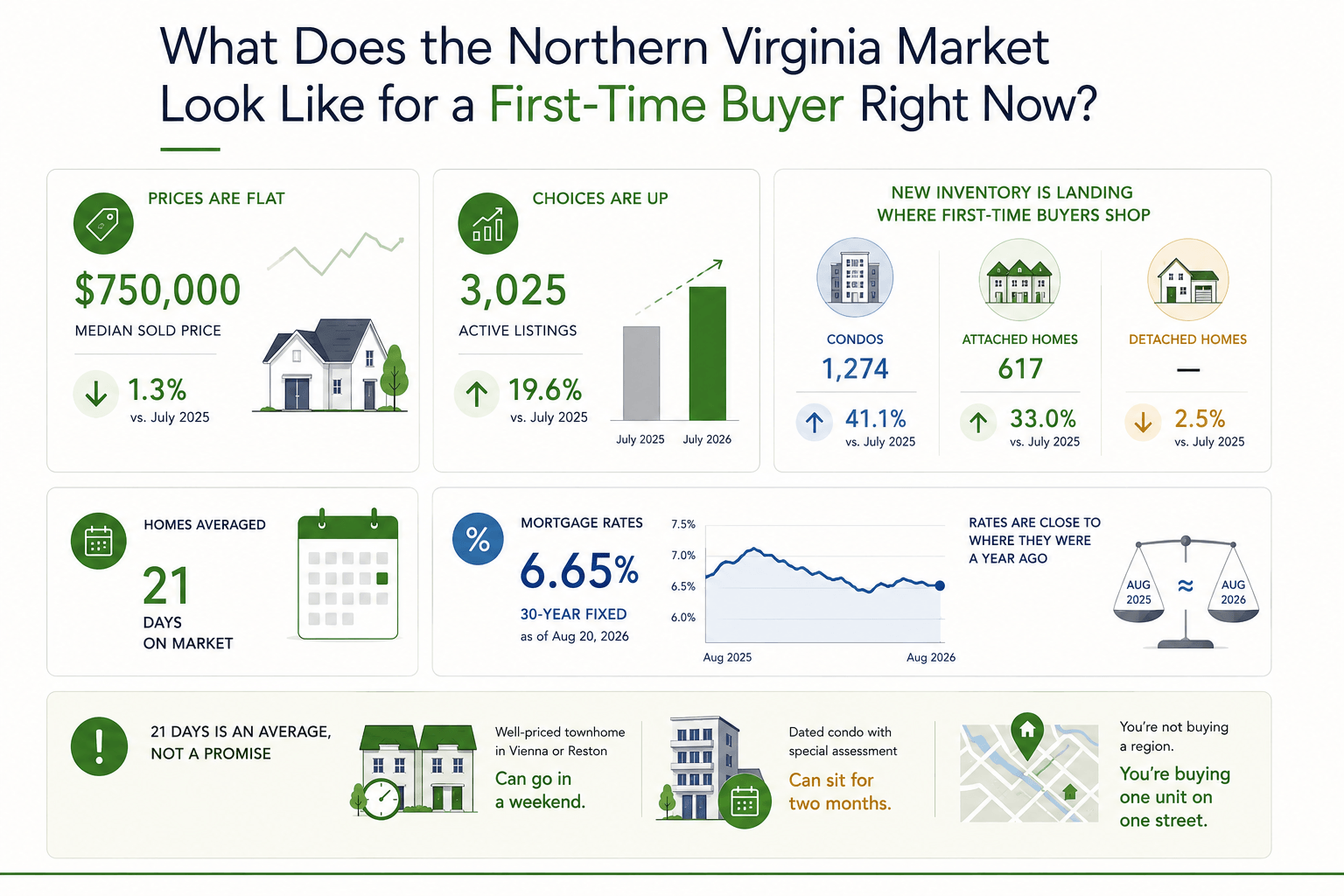
Prices are flat, choices are up, and the new inventory is landing exactly where first-time buyers shop. In July 2026 the median sold price was $750,000, down 1.3% from a year earlier, and homes averaged 21 days on market, according to the Northern Virginia Association of Realtors.
The inventory story is the one to pay attention to. Active listings hit 3,025 units in July, up 19.6% year over year. Condo inventory rose 41.1% to 1,274 units. Attached homes rose 33.0% to 617 units. Detached inventory actually fell 2.5%.
Read that again. The extra supply is in condos and townhomes. That is the entry point for most first-time buyers here.
Rates are the other half of the math. The 30-year fixed averaged 6.65% as of August 20, 2026, per the Freddie Mac Primary Mortgage Market Survey. That is close to where it sat a year ago, so waiting for a rate rescue has not paid off for the buyers who tried it.
One caution from 24 years of doing this locally: 21 days is an average, not a promise. A well-priced townhome in Vienna or Reston can still go in a weekend. A dated condo in a building with a special assessment can sit for two months. You are not buying a region. You are buying one unit on one street.
Where do first-time buyers find entry points?
Condos and townhomes, in that order. That is where the 41.1% and 33.0% inventory jumps landed, and it is the only part of this market where a buyer has real negotiating room right now.
County choice moves the number too. Loudoun County posted a median sold price of $813,000 in July 2026, well above the regional $750,000. Condo buildings closer in often start far below both. Two buyers with identical budgets end up in completely different searches depending on which line on the map they draw first.
For the full quarterly picture, see our Northern Virginia housing market report.
How much cash do you actually need to close?
Plan on your down payment plus 2% to 5% of the purchase price in closing costs. The Consumer Financial Protection Bureau puts closing costs in that range, and it is separate from the down payment.
Here is what that looks like at three Northern Virginia price points. Closing costs are shown at 3% for illustration.
| Purchase price | 3% down (conventional) | 3.5% down (FHA) | Closing costs at 3% | Cash needed at 3% down |
|---|---|---|---|---|
| $450,000 | $13,500 | $15,750 | $13,500 | $27,000 |
| $600,000 | $18,000 | $21,000 | $18,000 | $36,000 |
| $750,000 | $22,500 | $26,250 | $22,500 | $45,000 |
Those closing cost numbers cover lender fees, title insurance, settlement fees, Virginia recordation and recording taxes, and prepaid property taxes and insurance. Your earnest money deposit is not an extra cost. It is credited back to you at settlement.
Two things move that cash number in your favor. A seller credit toward closing costs, which is more common now that buyers have more choices. And assistance programs, which is the next section.
What will the monthly payment look like?
At 6.65%, principal and interest on a 3% down loan runs about $2,800 a month on a $450,000 condo, about $3,740 on a $600,000 townhome, and about $4,670 on a $750,000 home.
That is principal and interest only. Add property taxes, homeowners insurance, mortgage insurance, and, if you buy a condo or a home in an association, the monthly fee. Association fees in this region are a real line item, not a rounding error, and lenders count them in your debt ratio. Ask for the fee amount and what it covers before you write the offer.
Get a Loan Estimate from at least three lenders. The form is standardized, so you can compare line by line. Origination and title charges are where the spread shows up.
First time home buyer Northern Virginia programs: what Virginia Housing offers
Virginia Housing runs the main statewide programs, and the income limits here are higher than most buyers expect. There are three that matter: a Down Payment Assistance Grant you never repay, a Closing Cost Assistance Grant for RHS and VA bond loans, and a Plus Second Mortgage that covers the down payment for buyers over the grant income limits.
These are the limits for the Washington, Arlington, Alexandria area, effective August 1, 2026, published by Virginia Housing. That area covers Alexandria, Arlington County, Fairfax County, the City of Fairfax, Falls Church, Loudoun County, Prince William County, Manassas, and Manassas Park.
| Program | Income limit, 2 or fewer people | Income limit, 3 or more people | Sales price / loan limit |
|---|---|---|---|
| Down Payment and Closing Cost Assistance Grants | $148,000 | $174,000 | $800,000 |
| Standard bond loan programs | $186,000 | $217,000 | $800,000 |
| Expanded, non-bond programs | $245,000 (all household sizes) | $245,000 (all household sizes) | No sales price limit |
Look at the $800,000 sales price cap next to the $750,000 median. At or below the regional median, the grant programs are live for you. In McLean or Great Falls, they usually are not. That single number decides where a first time home buyer Northern Virginia shopper should focus the search if assistance is part of the plan.
What do you have to do to qualify?
- No ownership interest in a primary residence in the past three years.
- An eligible Virginia Housing first mortgage through an approved lender.
- Household income and sales price inside the limits above.
- A Virginia Housing homebuyer education course. It is free and it is online.
- The home has to be your primary residence.
Full program details are on the Virginia Housing loans and grants page. Grant funds are limited and program terms change, so confirm current availability with your lender before you write an offer.
Which county programs can stack on top?
County programs are the most overlooked money in the first time home buyer Northern Virginia playbook. Three of the six counties run their own, and they can pair with a Virginia Housing loan. Funds are limited and most are first come, first served.
Fairfax County
The First-Time Homebuyers Program sells Affordable Dwelling Units and Workforce Dwelling Units to income-qualified buyers at prices well below the surrounding market. The trade-off is real: resale price controls run for 30 years. Separately, the Fairfax County Redevelopment and Housing Authority has offered down payment loans of up to $50,000 to households at or below 80% of area median income, which the county described as roughly $131,000 for a family of four.
Arlington County
The Moderate Income Purchase Assistance Program provides down payment and closing cost help for purchases inside Arlington. Read the repayment terms closely. This assistance is deferred, not forgiven.
Loudoun County
Loudoun runs down payment and closing cost assistance for buyers who have lived or worked in the county for at least six months, alongside its Affordable Dwelling Unit purchase program. Check current funding with the county before you count on it.
Which loan actually fits a first-time buyer here?
Four loan types cover almost every first-time buyer in this market. The right one depends on your credit, your cash, and whether you have VA eligibility.
- Conventional 3% down. Best if your credit is strong. Private mortgage insurance comes off once you reach 20% equity, which is the biggest long-term advantage.
- FHA 3.5% down. More forgiving on credit and debt ratios. The catch: with a low down payment, the mortgage insurance premium stays for the life of the loan unless you refinance out of it later.
- VA loan, zero down. For eligible service members, veterans, and some surviving spouses. No monthly mortgage insurance. In a region this heavy with federal and military households, this is the most underused tool on the list.
- Virginia Housing loans. Thirty-year fixed products, some with reduced or no mortgage insurance, and the only way to access the state grants above.
What credit score do you need?
FHA allows the 3.5% down payment at a credit score of 580 or higher. Below 580, the down payment requirement jumps to 10%. Conventional and Virginia Housing lenders generally want 620 or better.
Score does more than set your rate. It sets your mortgage insurance cost, which on a low down payment loan can swing the monthly payment by more than the rate does. If you are three months out and sitting in the 600s, paying down revolving balances is usually the highest-return thing you can do with your time.
What if you are a federal, contractor, or military buyer?
Use the VA loan if you have eligibility. Zero down, no monthly mortgage insurance, and the funding fee is waived for veterans receiving compensation for a service-connected disability.
If you are moving on orders, build the timeline backward from your report date and get the loan file cleared early. Remote and mail-away signings are routine here. So are contracts written by a buyer who has never seen the house in person. Neither is a reason to skip the inspection.
Will you get pushed into a jumbo loan?
Almost certainly not. For 2026 the baseline conforming loan limit is $832,750 and the high-cost ceiling is $1,249,125, per the Federal Housing Finance Agency. Northern Virginia counties are treated as high cost, so first-time buyer price points sit far below the limit. Confirm the exact county figure with your lender, since limits are set county by county.
What changed for buyers after the NAR settlement?
Since August 2024, you sign a written buyer representation agreement before you tour homes, and the MLS no longer publishes what a seller is offering the buyer’s agent. You now negotiate your agent’s fee directly, in writing, before the search starts.
That agreement is a real document. Three questions to ask before you sign:
- What exactly is your fee, and how long does this agreement run?
- What happens if the seller offers less than that, or nothing at all? Who covers the gap?
- Can I cancel, and how?
One practical effect: seller concessions now do double duty. In a market with 19.6% more listings than a year ago, a seller credit can go toward your closing costs, toward your agent’s fee, or toward buying down your rate. Ask your lender which use saves you the most before you decide how to structure the offer.
This is also where buyer rebates entered the conversation. Some brokerages return part of the buyer-side commission to the buyer at settlement. At RealtyPeople the structure is 1% cash back at closing. On a $750,000 purchase, that is roughly $7,500 back, and buyers commonly apply it to closing costs. Buyers can receive that amount when the seller offers a cooperating commission of 1% or more. Actual amounts vary by transaction.
The mechanics are worth understanding before you sign anything, so read how buyer cash back works in Virginia and the broader guide to buying a home in Northern Virginia with 1% cash back.
What is the step-by-step process from pre-approval to keys?
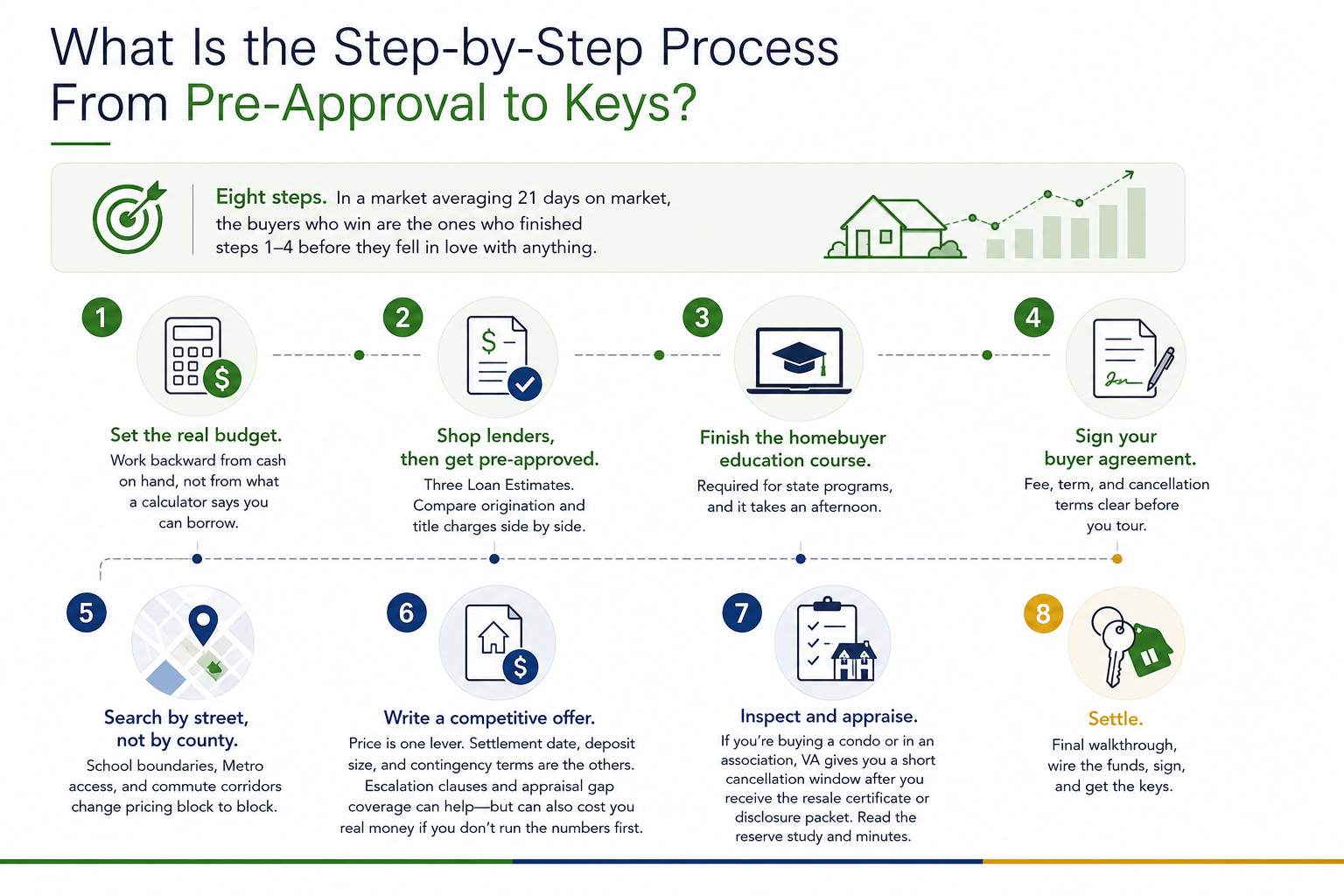
Eight steps. In a market averaging 21 days on market, the buyers who win are the ones who finished steps one through four before they fell in love with anything.
- Set the real budget. Work backward from cash on hand, not from what a calculator says you can borrow.
- Shop lenders, then get pre-approved. Three Loan Estimates. Compare origination and title charges side by side.
- Finish the homebuyer education course. Required for the state programs, and it takes an afternoon.
- Sign your buyer agreement. Fee, term, and cancellation terms clear before you tour.
- Search by street, not by county. School boundaries, Metro access, and commute corridors change pricing block to block.
- Write a competitive offer. Price is one lever. Settlement date, deposit size, and contingency terms are the others. In a multiple-offer situation you will hear about escalation clauses, which raise your price automatically up to a cap, and appraisal gap coverage, which is your promise to bring extra cash if the appraisal comes in low. Both are useful. Both can cost you real money if you use them without running your own numbers first.
- Inspect and appraise. If you are buying a condo or a home in an association, Virginia gives you a short cancellation window after you receive the resale certificate or disclosure packet. Ask your agent for the exact number of days that applies to your contract, and actually read the reserve study and the minutes for special assessments.
- Settle. Final walkthrough, wire the funds, sign, and get the keys.
What mistakes do first-time buyers make in Northern Virginia?
Five, over and over. Each one is avoidable in an afternoon.
- Shopping for a house before shopping for a lender. You lose the first house you actually want.
- Budgeting the down payment and forgetting the closing costs. On a $600,000 purchase that gap is around $18,000.
- Assuming assistance is only for very low incomes. The grant limit for a two-person household here is $148,000. Plenty of dual-income buyers screen themselves out for no reason.
- Skipping the condo or association documents. A pending special assessment can cost more than every closing fee combined.
- Waiving the inspection to win a bidding war. There are smarter tools now that inventory is up 19.6%. Shorten the timeline or negotiate the scope instead of giving up the protection entirely.
Your next step
Get pre-approved first. Then get a plan for the specific streets you are shopping, with the assistance programs you qualify for already mapped in. A first time home buyer Northern Virginia plan on paper takes one conversation and saves months of guessing.
Start here: Buy a Home. Tell us your timeline and your target areas, and we will walk through the numbers for your situation. No pressure and no obligation.
Frequently asked questions
How much do you need for a down payment as a first time home buyer Northern Virginia?
As little as 3% on a conventional loan, 3.5% on FHA, and zero on a VA loan if you are eligible. At the July 2026 regional median of $750,000, that is $22,500 to $26,250, plus 2% to 5% of the price in closing costs.
What are the income limits for Virginia Housing first-time buyer programs in Northern Virginia?
For the Washington, Arlington, Alexandria area, effective August 1, 2026: $148,000 for households of two or fewer and $174,000 for three or more on the grant programs, with a $800,000 sales price limit. Standard bond loan limits are higher at $186,000 and $217,000.
Do first-time buyers have to sign a buyer agreement in Virginia?
Yes. Since the NAR settlement took effect in August 2024, buyers sign a written representation agreement with their agent before touring homes. The agreement states the agent’s fee, and that fee is negotiable.
Is 2026 a good time to buy a first home in Northern Virginia?
Buyers have more choice than they have had in years. Active listings were up 19.6% in July 2026, condo inventory was up 41.1%, and the median price was down 1.3% year over year. Nobody can guarantee where prices go next, so the better question is whether your cash, credit, and timeline are ready.
Can I use a Virginia Housing grant and a county program at the same time?
Often yes. The Down Payment Assistance Grant can be paired with non-Virginia Housing assistance, and county programs in Fairfax, Arlington, and Loudoun are designed to layer on top. Confirm the specific combination with your lender, because funds are limited and terms change.

About Michael Gorman
Michael Gorman is the founder and Principal Broker of RealtyPeople in McLean, Virginia. He holds an MBA from Harvard Business School, has closed more than 2,000 transactions and $2 billion in volume over 24+ years in Northern Virginia, and has been an NVAR Top Producer at the Diamond level for 10+ consecutive years. Before founding the brokerage, he was Senior Vice President of Business Development at Long & Foster. Read his full background.
View profile →Compliance and disclosures: Equal Housing Opportunity. Licensed real estate brokerage in the Commonwealth of Virginia. This guide is general information, not lending, tax, or legal advice. Program terms, income limits, and loan limits change. Verify current figures with your lender and the program administrator before you rely on them.
