
Selling your home yourself gives you full control. It also hands you every job an agent would normally do. That is the honest summary of the pros and cons of FSBO Northern Virginia sellers face: you keep the listing-side fee and the decisions, and you take on the marketing, the negotiation, and the paperwork.
FSBO can work. It is also rare. In the National Association of REALTORS® 2025 Profile of Home Buyers and Sellers, only 5% of sales were for sale by owner, a record low (Virginia REALTORS®, 2025).
This guide walks through the real trade-offs, the situations where FSBO makes the most sense, and the Northern Virginia details that make a sale harder than it looks. For the dollar math of FSBO versus hiring an agent, see our FSBO vs realtor cost comparison for Virginia. If you already tried FSBO and it stalled, our guide to the lower-cost alternative when FSBO didn’t work picks up from there.
I have spent 24+ years in Northern Virginia real estate and closed more than 2,000 transactions. Some of the smoothest sales I have seen were simple. Some of the hardest started as simple. The difference is usually in the details below.
Pros and Cons of FSBO Northern Virginia: what are the real trade-offs?
The upside is real: you avoid a listing-agent fee and you control every conversation. The cost is that marketing, negotiation, and transaction management all become your job.
Commissions are also negotiable either way. NAR’s consumer guide states that agent compensation is fully negotiable and not set by law (NAR, 2024). So the real choice is which work you want to own, and which work you want to pay someone else to handle.
| Area | Benefit of FSBO | Risk of FSBO | Your responsibility |
|---|---|---|---|
| Listing fee | No listing-agent fee | A buyer’s agent may still expect to be paid | Decide whether to offer anything to a buyer’s agent |
| Control | You set showings, price, and terms | Every decision lands on you | Respond to every inquiry and request |
| Marketing | You choose how to present the home | Less reach if buyers never see it | Photos, listing text, and where it appears |
| Pricing | You pick the number | Overpricing or underpricing without data | Pull and read recent comparable sales |
| Negotiation | Direct contact with the buyer | Harder to stay objective about your own home | Counteroffers, repair requests, and credits |
| Paperwork | Nothing is hidden from you | Missed disclosures or deadlines | Contract, disclosures, and settlement coordination |
Sources for fee negotiability: NAR, Consumer Guide: Listing Agreements (2024). Table categories reflect common seller responsibilities. They are a planning aid for your own sale.
What does control look like in practice?
Picture a seller in Vienna who wants tight control over showings. With FSBO, they can say no to Tuesday nights and yes to Saturday mornings. Nobody books a showing without their approval.
Now picture the same seller at work on a Wednesday. Three buyers call at 11 a.m. One asks about the roof. One wants a showing today. One wants to know if you will accept a contingent offer. With FSBO, every one of those calls is yours, during your workday.
That is the core of the pros and cons of FSBO Northern Virginia sellers should weigh: control and responsibility arrive together. You cannot keep one and hand off the other.
Does already knowing the buyer change the equation?
Yes, it changes the hardest part. If you already have a buyer, you skip most of the marketing and buyer-finding work. You still have a full contract, disclosures, and a settlement to manage.
This is the single biggest pattern in FSBO data. NAR found that 60% of FSBO sellers knew the buyer of their home (NAR, 2025). Virginia REALTORS® reports that for 30% of FSBO sellers, the main reason for selling FSBO was that they sold to a friend, relative, or neighbor (Virginia REALTORS®, 2025).
In other words, a lot of successful FSBO sales start with a buyer already in hand. The seller is managing a transaction more than running a marketing campaign.
What still matters in a neighbor-to-neighbor sale?
Take a hypothetical: your neighbor in Vienna has wanted your house for years, and you agree on a price over the fence. That saves weeks of showings. Here is what it does not replace:
- A written, ratified contract. Price, deposit, contingencies, and settlement date all need to be on paper.
- Disclosures. Virginia’s disclosure rules still apply. A sale to a neighbor or friend is not on the statute’s list of exempt transfers.
- The buyer’s lender. If the neighbor is financing, their lender will order an appraisal and set its own deadlines.
- A settlement agent. Someone still has to handle title, payoffs, and recording.
Illustration only. Hypothetical Vienna neighbor sale. This is not a documented transaction.
Knowing the buyer lowers the marketing risk. It does not lower the legal and contract risk. Friendly deals can get tense fast when a repair request or an appraisal gap shows up.
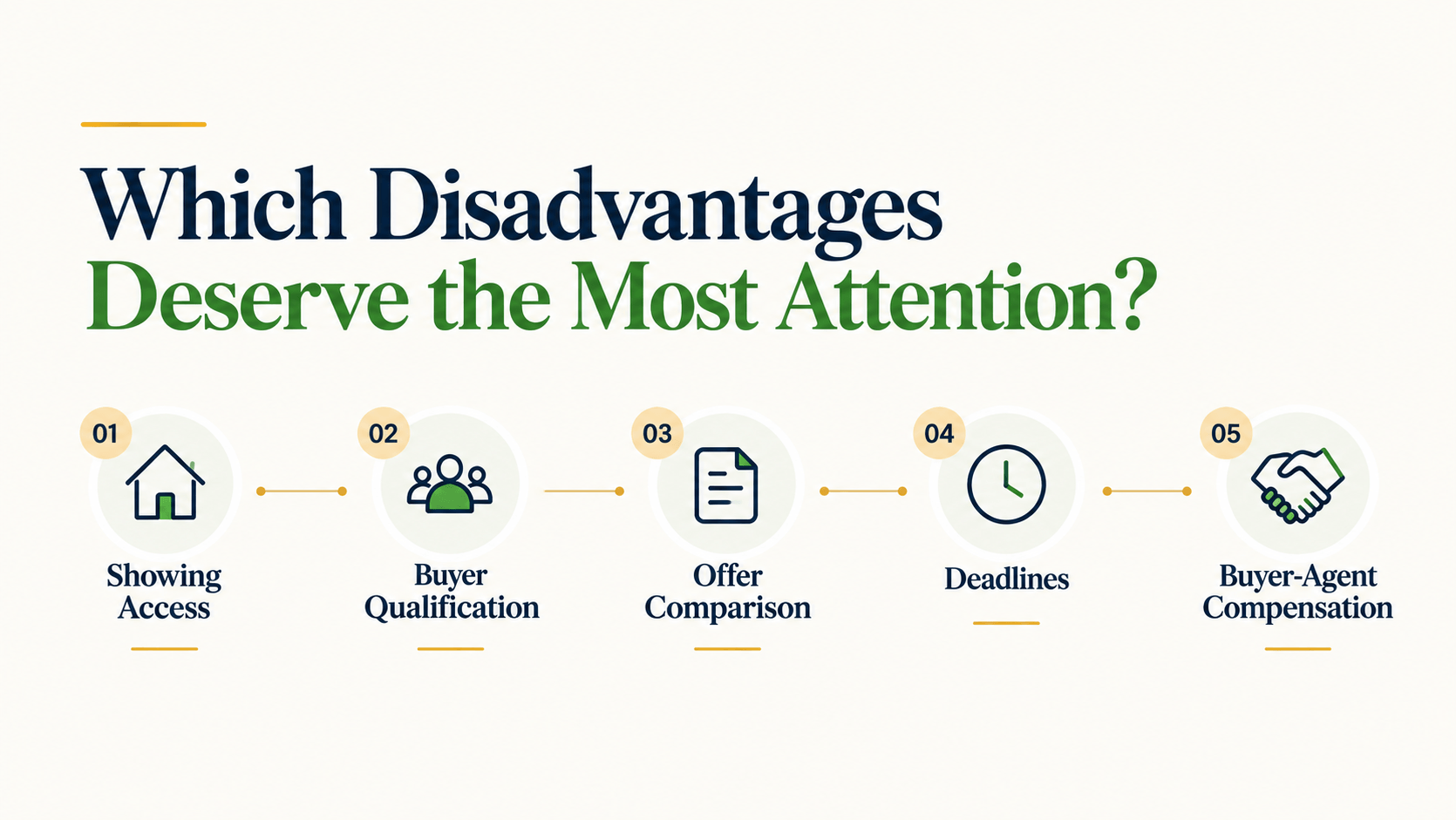
Which disadvantages deserve the most attention?
Separate the challenges you can work around, such as exposure and negotiation, from the obligations you cannot skip, such as disclosures and contract deadlines. The first group costs you time and leverage. The second can cost you the deal.
Start with exposure. NAR’s 2025 data shows 88% of buyers purchased through an agent or broker (NAR, 2025). That does not mean FSBO homes cannot reach those buyers. It means your home has to be easy for buyer agents to find, show, and write offers on.
These are the FSBO mistakes to avoid that deserve the most attention:
- Showing access. Buyer agents need a clear way to book showings. If you are hard to reach, many will move on to the next home.
- Buyer qualification. Ask for a pre-approval letter or proof of funds before you accept an offer. A handshake is not a qualified buyer.
- Offer comparison. The highest price is only one term. Compare financing, contingencies, deposit, and settlement date side by side.
- Deadlines. Inspection, financing, appraisal, and document deadlines run on the contract clock. Missing one can change your rights or the buyer’s.
- Buyer-agent compensation. You decide whether to offer anything. NAR says that choice is up to you, and it is negotiable.
Those are the parts of the pros and cons of FSBO Northern Virginia sellers underestimate most. Pricing and photos get the attention. Deadlines and paperwork decide whether the sale closes.
If you are selling by owner Northern Virginia style, with a full-time job and a busy calendar, be honest about which of these you can handle well.
What does a qualified offer look like?
When an offer arrives, look for proof before you look at price. A qualified offer usually shows you:
- A pre-approval letter from a named lender, or proof of funds for a cash buyer
- The deposit amount and who will hold it
- Each contingency, such as inspection, financing, and appraisal, with its deadline
- The proposed settlement date and the settlement agent
If any of those are missing, ask for them before you respond. A clear offer protects you. A vague one hands the buyer room to walk away later.
Which Northern Virginia property details increase complexity?
Condos and homes in associations add resale certificate rules and cancellation rights. Older homes add federal lead disclosure rules. Both add deadlines you have to manage yourself.
What changes when you sell a condo in Arlington?
Take a hypothetical Arlington condo. In Virginia, the association must deliver the resale certificate within 14 days after a written request (Virginia Code § 55.1-2309).
Once the buyer receives it, they have three days to cancel the contract, unless the contract sets a different period. If the certificate or a notice that it is unavailable is never delivered, the buyer can cancel at any time before settlement (Virginia Code § 55.1-2312).
So the timing depends on delivery. Order the certificate early. A late certificate keeps the buyer’s cancellation window open, and that window runs on your deal.
What changes when you sell an older home in Alexandria?
Now take a hypothetical older home in Alexandria built before 1978. Federal lead rules cover most pre-1978 housing. Before the buyer is bound by the contract, you must:
- Give the buyer the EPA pamphlet Protect Your Family From Lead in Your Home
- Disclose any known information about lead-based paint and lead-based paint hazards
- Give the buyer a 10-day opportunity to conduct a lead inspection or risk assessment
The parties can agree in writing to lengthen or shorten that 10-day period, and the buyer can waive it (EPA, updated May 27, 2026).
Illustrations only. Hypothetical Arlington condo and Alexandria home. These are not documented transactions. Have a Virginia real estate attorney review your contract and disclosures.
Neither rule is hard to follow once you know it exists. The risk in a for sale by owner Virginia sale is not knowing it exists until the buyer’s attorney points it out.
How should sellers weigh control against execution risk?
Score four things: your access to buyers, your available time, your property’s complexity, and the professional support you are willing to pay for. Neither route wins every time.
You will see national medians quoted in this debate. In NAR’s 2025 data, FSBO homes sold for a median of $360,000 and agent-assisted homes for a median of $425,000 (Virginia REALTORS®, 2025).
Read that carefully. Those are medians for different groups of homes. Many FSBO sales go to friends, relatives, and neighbors, and the homes themselves can differ. The gap is not a measure of what an agent adds to any one sale.
A better approach is to score your own situation:
| Factor | FSBO fits better when | Professional help fits better when |
|---|---|---|
| Buyer access | You already have a qualified buyer | You need to reach buyers working with agents |
| Your time | You can answer calls and show during the day | Your schedule is full or you live elsewhere |
| Property complexity | Detached home, no HOA, built after 1978 | Condo, HOA, pre-1978 home, or unusual features |
| Price confidence | Recent comparable sales are clear | Comparables are thin or mixed |
| Negotiation comfort | You can stay objective about your own home | Repair and credit talks would be stressful |
| Support budget | You will pay an attorney or settlement agent | You want one professional managing the whole process |
Decision guide only. Scores depend on your home and your situation.
If most of your answers land in the left column, FSBO may be a reasonable choice. If most land in the right, you are taking on execution risk you may not want.
If you do try FSBO, set a checkpoint before you list. Pick a date to review showings, feedback, and offers. Decide in advance what you will change if the numbers are weak: the price, the marketing, or the route itself. Sellers who set that checkpoint early make the call with a clear head. Sellers who skip it tend to make it after weeks of frustration.
The pros and cons of FSBO Northern Virginia sellers weigh often point to a middle path. Some sellers want full service without a full traditional fee. RealtyPeople’s $500 + 1% listing model is one example of that structure. The FSBO vs realtor cost comparison linked above runs those numbers in detail.
What do sellers commonly ask?
What are the pros and cons of FSBO Northern Virginia homeowners should weigh?
The pros are no listing-agent fee and full control over showings, pricing, and terms. The cons are that you handle marketing, buyer qualification, negotiation, disclosures, and deadlines yourself.
Does FSBO eliminate every agent fee?
Not always. If the buyer has an agent, that agent is paid under the buyer’s own agreement, and the buyer may ask you to cover some of it in the offer. Whether you agree is up to you, and it is negotiable.
Does a known buyer remove disclosure obligations?
No. Virginia’s Residential Property Disclosure Act exempts specific transfers, such as those between co-owners or to a spouse or lineal family member, and a sale to a friend or neighbor is not on that list (Virginia Code § 55.1-702). Federal lead rules also apply to most pre-1978 homes regardless of who the buyer is.
Can sellers purchase limited professional help?
Yes. Virginia law allows a limited service agent, who must list in writing the services they will and will not provide (Virginia Code § 54.1-2138.1). You remain responsible for any duties that agent does not take on.
Your next step
Whether you sell FSBO, with an agent, or somewhere in between, the same handful of mistakes costs sellers the most money. Knowing them in advance is the cheapest protection you can buy.
Download the Top 10 Mistakes Sellers Make Guide. Use it as a checklist before you set a price, sign a contract, or answer your first buyer call. No pressure and no obligation.

About Michael Gorman
Michael Gorman is the founder and Principal Broker of RealtyPeople, a full-service brokerage serving Northern Virginia. He holds a Harvard MBA, has 24+ years in the business, 2,000+ transactions closed, and more than $2 billion in volume. He is an NVAR Diamond Top Producer for 10+ consecutive years and a former Senior Vice President at Long & Foster. Mike runs every file personally, start to finish.
View profile →Compliance and disclosures: Savings figures use “can save” examples, not guarantees. They assume a 2.5% seller-paid listing commission under a traditional model, separate from any buyer-agent compensation. Buyer cash back assumes the seller offers a buyer-agent commission of at least 1% and is subject to loan-program limits. Commission and fee data are from 2026 industry sources; price context is from NVAR. No outcome on sale price, time on market, or savings is guaranteed. This article is general information, not legal, tax, or financial advice.
RealtyPeople is a licensed real estate brokerage in Virginia. Michael Gorman is a licensed Principal Broker in Virginia. Equal Housing Opportunity.
