
The lowest advertised percentage is rarely the best deal. The sellers who save money on realtor fees negotiate specific charges, keep the services they need in writing, and protect the number that matters most: what they walk away with at closing.
This guide shows you which charges you can negotiate, how to ask, and how to keep a discount from disappearing later in the deal. For typical rates and who pays what, see how much you pay a realtor when you sell in Virginia. For how a lower listing fee works end to end, see our guide to a low commission realtor in Northern Virginia.
I have spent 24+ years in Northern Virginia real estate and closed more than 2,000 transactions. Most of the money sellers lose on fees is lost in the fine print and the final negotiation, long after the rate is agreed.
Save money on realtor fees: which charges can you negotiate?
You can negotiate the listing compensation, any extra brokerage charges, and the scope of service before you sign. No law fixes the commission rate, and Virginia requires the fee, payment terms, and services to be written into your agreement.
NAR’s consumer guide states that agent compensation is fully negotiable and not set by law (NAR, 2024). Virginia’s brokerage statute requires a written agreement that states the brokerage fee, how and when it is paid, and the services the agent will provide (Virginia Code § 54.1-2137).
That gives you a checklist. Every charge in the agreement is a line you can ask about. Here is how to work through them:
| Charge | What to request | Service to keep | Get it in writing |
|---|---|---|---|
| Listing compensation | A specific lower percentage or flat fee | Pricing, marketing, and negotiation | Rate or dollar amount in the fee section |
| Listing broker service fee | Removal or reduction | Same service list | Fee line struck or amended |
| Upfront retainer | Removal, or credit toward the final fee | No change | Credit box checked |
| Marketing extras | Included in the fee | Photos, MLS exposure, showings | Services listed by name |
| Early termination fee | Removal or a lower amount | Your right to leave | Termination terms amended |
Table rows reflect common line items in Northern Virginia listing agreements. Your agreement may differ.
Here is how the math works. On a hypothetical $1,000,000 sale in McLean, cutting a listing fee from 2.5% to 2% lowers it from $25,000 to $20,000. That is $5,000 before any other changes to the deal.
Illustration only. Hypothetical McLean sale. This is not a documented transaction or a quote.
That $5,000 is real, but it is only the starting point. To save money on realtor fees for good, you have to keep it through every other line of the agreement and every step of the sale.
How should you negotiate realtor commission?
Ask for a specific number, give a clear reason, and compare written quotes. Avoid promising referrals or outcomes you cannot control.
When you negotiate realtor commission, a vague request gets a vague answer. Try this structure:
- Name the number. Ask for a specific percentage or dollar amount, such as 2% instead of 2.5%.
- Give the reason. Explain why your listing should take less work: the home is prepped, priced to recent sales, and easy to show.
- Show the comparison. If another agent quoted less for the same services, share the written quote.
- Stay honest. Skip promises of future referrals or a fast sale. Neither belongs in a fee negotiation.
Asking tends to work. In a LendingTree survey of 2,034 U.S. consumers from January 17-19, 2024, only 31% of homebuyers or sellers tried to negotiate their agent’s commission. Of those who asked, 64% succeeded (LendingTree, 2024).
Read that data carefully. It covers people who chose to ask, and it was collected before the August 2024 practice changes from the NAR settlement. It shows that flexibility often exists. It does not predict your result.
LendingTree senior economist Jacob Channel put it simply: “Like most things in life, you won’t know if your real estate agent will be willing to lower their commission fee until you ask” (LendingTree, 2024).
What if the agent says no?
A no on the rate is not the end of the conversation. Ask what would make a lower fee work for them. Common answers include a different fee structure, such as a flat fee or a percentage plus a set dollar amount, or a change in scope you are comfortable with.
Then decide with the numbers in front of you. If the agent holds the rate but removes a service fee and credits the retainer, you may still come out ahead. If nothing moves, compare their full written terms with your other quotes and choose the one with the best service list for the total cost.

How can lower listing fees preserve full representation?
Either get the same written services at a lower price, or knowingly accept a narrower scope. The mistake is paying less and assuming nothing changed.
Before you compare prices, write down the services you expect. At a minimum, confirm these are in every quote:
- Professional photography
- MLS exposure and syndication to major portals
- Showing coordination and buyer feedback
- Offer review and negotiation
- Inspection and repair negotiation support
If a lower quote drops any of these, you are buying a different product. Virginia allows limited service agents, but the agreement must list the specific duties the agent will not provide, and you remain responsible for them (Virginia Code § 54.1-2138.1). Our comparison of discount brokerage vs full-service low commission walks through the difference.
Full service at a lower fee is a structure some brokerages are built around. RealtyPeople’s model is $500 + 1% for sellers, with pricing guidance, photography, MLS exposure, negotiation, and closing support included. On a $700,000 home, a seller can save about $10,000 in listing fees with that structure.
Assumes a 2.5% seller-paid listing commission under a traditional model. Savings depend on the specific deal.
Whatever brokerage you choose, the test is the same. You save money on realtor fees only when the written service list stays the same while the price comes down.
Which additional fees can erase the discount?
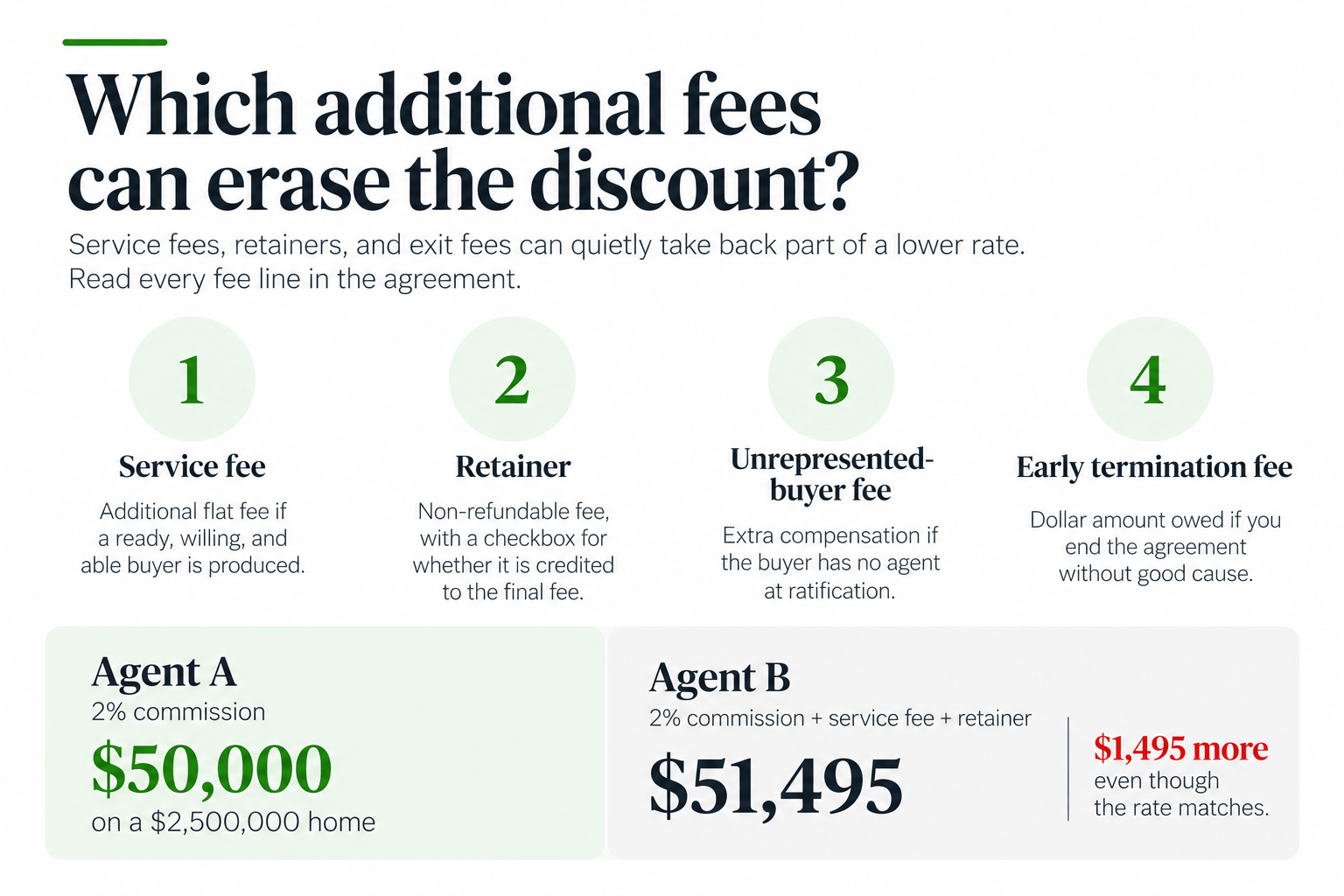
Service fees, retainers, and exit fees can quietly take back part of a lower rate. Read every fee line in the agreement, and ask for each one to be removed, reduced, or credited in writing.
The standard Northern Virginia listing form, NVAR’s Exclusive Right to Sell Listing Agreement (K1336), has separate blanks for several extra charges (NVAR K1336, v08/24):
- Listing broker service fee (Section 6.D). An additional flat fee owed if a ready, willing, and able buyer is produced.
- Retainer (Section 6.E). A non-refundable fee earned when paid, with a checkbox for whether it will or will not be subtracted from the final compensation.
- Unrepresented-buyer fee (Section 6.B). Extra compensation if the buyer has no agent at ratification.
- Early termination fee (Section 6.F). A dollar amount owed if you end the agreement without good cause.
Say two agents both quote 2%. One also charges a $995 service fee and a $500 retainer that is not credited. That quote costs $1,495 more than the other, even though the rate matches.
Illustration only. Hypothetical fees. These are not quotes from any brokerage.
Do not assume a retainer and a service fee overlap or cancel out. Ask directly: “Is the retainer credited toward the final fee?” and “What does the service fee cover that the commission does not?” Then get the answers written into the agreement.
How do you protect real estate commission savings during negotiations?
Look at buyer-agent compensation together with price, concessions, and closing certainty. A fee you saved at listing can come back as a credit at the negotiating table.
Offering compensation to a buyer’s agent is your choice. NAR’s consumer guide says your agent can only offer or pay compensation to a buyer’s agent with your written approval and signoff on the amount (NAR, 2024).
Concessions work differently. NAR notes that seller concessions can still be communicated in the MLS, but they cannot be conditioned on the buyer using or paying a broker (NAR, 2024).
Here is where real estate commission savings leak away. Say you saved a hypothetical $5,000 on your listing fee. Then, during inspection talks, you agree to a repair credit $7,500 larger than you planned. You are $2,500 behind where you started.
Illustration only. Hypothetical figures to show how negotiation outcomes offset fee savings.
Zero buyer-agent compensation is not automatically the best choice either. A buyer who has to pay their own agent may ask for a lower price or a larger credit instead. Compare offers on your net proceeds, the one number that includes every line.
So to save money on realtor fees and keep it, judge every offer the same way: price, minus any buyer-agent compensation, minus credits and concessions, plus how likely the deal is to close. That net number is what realtor fees Northern Virginia sellers pay really come down to.
Your next step
Every fee conversation starts with one number: what your home is likely to sell for. That number turns percentages into dollars, so you can see what each quote really costs.
Get your Free Home Valuation Report. Then run each agent’s quote at that price before you sign anything. No pressure and no obligation.
What should sellers ask before signing?
Can I save money on realtor fees without reducing services?
Yes, if the lower fee comes with the same written service list. Compare quotes line by line and confirm that photography, MLS exposure, showings, and negotiation are all included.
Can an agent decline my proposed rate?
Yes. Compensation is negotiable on both sides, so an agent can decline, counter, or accept. If they decline, ask what service change or fee structure would work for both of you.
Is buyer-agent compensation included?
Usually not. Paying a buyer’s agent is a separate, optional choice, and your agent needs your written approval and the amount before offering it.
Should an upfront fee credit toward commission?
Ask for it. The standard Northern Virginia listing form has a checkbox for whether a retainer is subtracted from the final fee, so make sure the credit is written into your agreement.

About Michael Gorman
Michael Gorman is the founder and Principal Broker of RealtyPeople in McLean, Virginia. He holds an MBA from Harvard Business School, has closed more than 2,000 transactions and $2 billion in volume over 24+ years in Northern Virginia, and has been an NVAR Top Producer at the Diamond level for 10+ consecutive years. Before founding the brokerage, he was Senior Vice President of Business Development at Long & Foster.
View profile →Compliance and disclosures: Equal Housing Opportunity. Licensed real estate brokerage in the Commonwealth of Virginia. This guide is general information, not legal, tax, or financial advice. Market data changes monthly. Verify current figures before you rely on them.
