
Real estate commissions in Northern Virginia are negotiable. They were negotiable before the 2024 NAR settlement, and they still are today. This is the NAR settlement explained for Northern Virginia sellers and buyers in plain English: what changed on August 17, 2024, what Virginia law adds on top, and how to protect your money on either side of the deal.
Here is the short version. Sellers can no longer advertise buyer-agent pay in the MLS. Buyers sign a written agreement that states their agent’s fee before they tour a home. And the question of who pays the buyer’s agent moved out of the MLS and into your purchase contract.
I walk every buyer through the new commission structure on the first call, because the numbers now show up in two contracts instead of one. After 24+ years and more than 2,000 transactions in Northern Virginia, I have worked under both the old rules and the new ones.
Sellers can pair this with our breakdown of what a low commission realtor in Northern Virginia costs on the listing side. Buyers can read how to buy a home in Northern Virginia with 1% cash back next. For advice on a specific contract, talk to a Virginia real estate attorney.
NAR settlement explained for Northern Virginia sellers
The settlement changed disclosure and MLS rules. Commission rates stay open to negotiation, the same as before. Bright MLS, the MLS that serves Northern Virginia, removed its buyer-agent compensation field on August 14, 2024 (HousingWire). The national deadline for the new practice rules was August 17, 2024 (NAR).
The settlement came out of antitrust lawsuits over commission rules, and the National Association of REALTORS® changed its MLS rules nationwide. For a seller in Fairfax, Arlington, or Loudoun, it comes down to five rows.
| What you deal with | Before August 2024 | After August 17, 2024 |
|---|---|---|
| Buyer-agent pay in the MLS | The listing broker could post an offer to buyer brokers in the MLS. | No offers of compensation in the MLS. Offers can still be shared off the MLS. |
| Buyer agreements | Virginia already required written brokerage agreements. | Signed before touring a home, including live virtual tours. |
| Buyer-agent fee ceiling | Buyer agents were typically paid the amount offered in the MLS. | A buyer’s agent cannot receive more than the agreement states, from any source. |
| Seller concessions | Negotiated in the purchase contract. | Can be listed in the MLS. Cannot be tied to paying a buyer’s agent. |
| Commission rates | Negotiable. | Still negotiable. Not set by law. |
Sources: NAR, Written Buyer Agreements 101; NAR, Compensation, Commission and Concessions (2024); Virginia REALTORS®, NAR Settlement Details (2024).
That is the NAR settlement explained for Northern Virginia sellers in one table. The biggest shift is where the buyer-agent conversation happens. It used to be settled in the MLS before a buyer ever walked through your door. Now it gets negotiated inside each offer.
Bright MLS also added a seller concessions field in June 2024. Your listing can still offer help with a buyer’s closing costs, as long as that help does not depend on the buyer paying an agent.
What changed, and what stayed negotiable?
Three things changed: sellers must approve any payment to a buyer’s agent, those offers moved off the MLS, and buyers now agree to their agent’s fee in writing. Every fee stayed negotiable, including yours as a seller.
What needs your approval as a seller?
Your listing agent can only offer money to a buyer’s agent with your consent. Virginia REALTORS® guidance says listing brokers may share compensation with buyer brokers when the seller gives written consent (Virginia REALTORS®, 2024). Sellers can also agree to pay a buyer’s broker directly as a term of the purchase contract.
So your listing agreement should answer three questions in writing. Are you offering anything to a buyer’s agent up front? If so, how much? Or will you decide offer by offer? Any of the three can work. Each has a trade-off, so choose on purpose.
Where can offers of compensation still appear?
The MLS and platforms tied to it are off limits. NAR lists these channels instead:
- Phone calls, texts, and emails between the listing agent and buyer agents
- Flyers and property brochures
- The listing brokerage’s own website
- Signage
What is the difference between compensation and a concession?
Compensation is money you agree to pay the buyer’s broker. A concession is money you credit to the buyer, often for closing costs or a rate buydown. NAR says concessions can still be communicated in the MLS, but they cannot be conditioned on the buyer using or paying a broker (NAR, 2024). The wording in your contract matters, because lenders and loan programs can treat the two differently.
What stayed negotiable?
All of it. NAR’s own guidance says commissions are not set by law and are fully negotiable. That covers your listing fee, any amount you offer a buyer’s agent, and the fee a buyer agrees to pay their own agent.
Protect your equity by treating each of those as its own number. On a $700,000 home, every 1% you agree to pay is $7,000 out of your proceeds. At the same time, avoid assuming the buyer gets representation for free. Someone pays the buyer’s agent. The contracts decide who.
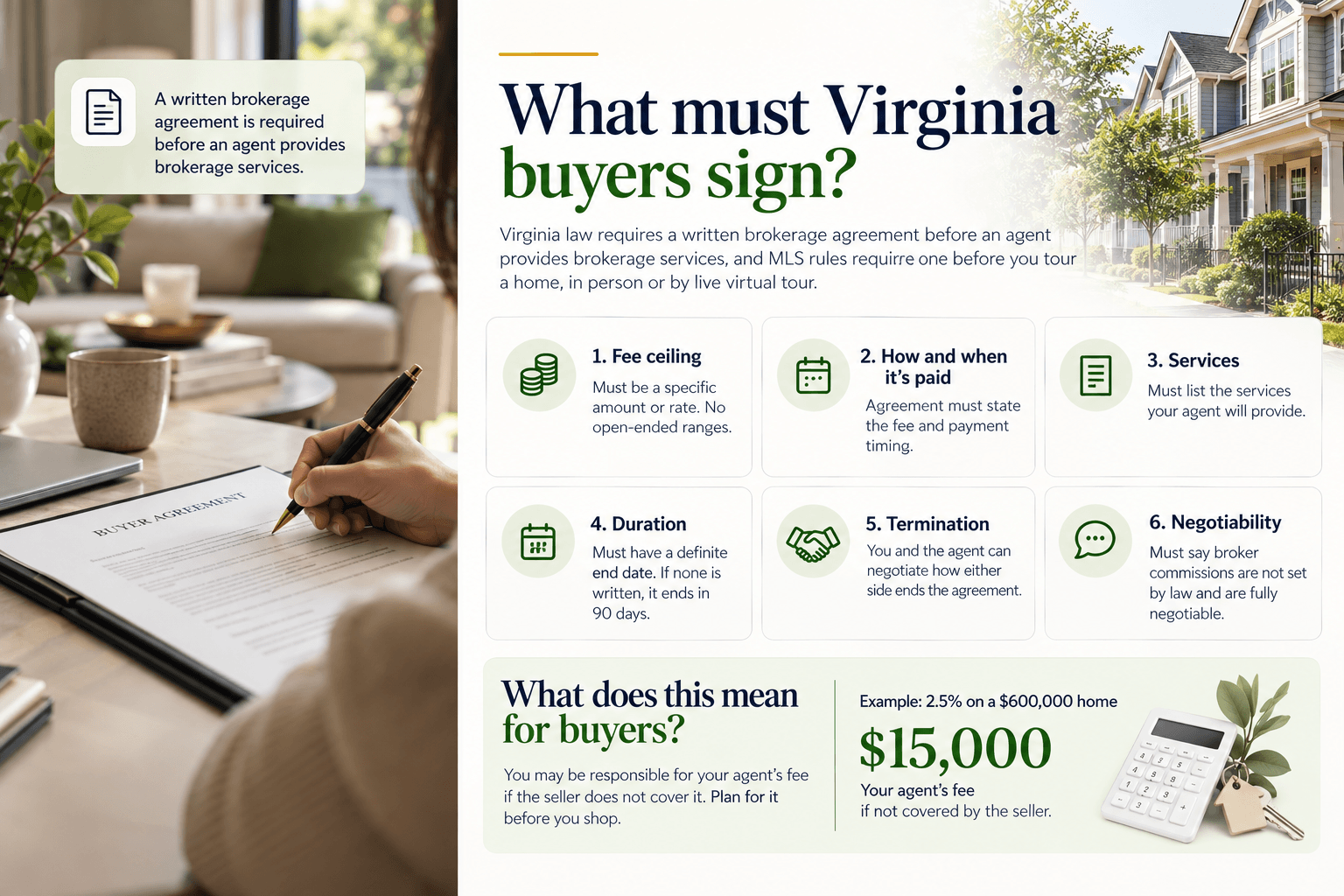
What must Virginia buyers sign?
Virginia law requires a written brokerage agreement before an agent provides brokerage services. MLS participants covered by the settlement must also have one signed before you tour a home, in person or by live virtual tour.
Virginia has required written brokerage agreements since the mid-1990s, so this part is older than the settlement (Virginia REALTORS®). A 2025 amendment made the timing explicit: a licensee shall enter into a brokerage agreement with a prospective client prior to providing brokerage services (Virginia Code § 54.1-2137). The one exception is an agent preparing property-specific materials to win your business.
So yes, a mandatory buyer representation agreement Virginia buyers must sign does exist. The settlement layered national MLS rules on top of it. The NAR settlement buyer agreement Virginia buyers sign today has to cover these points:
- Fee ceiling. The amount or rate must be specific and objectively ascertainable. No open-ended ranges. The agent cannot collect more than this from any source, seller included (NAR).
- How and when the fee is paid. Virginia law requires the agreement to state the brokerage fee and how and when it gets paid.
- Services. The agreement must list the services the agent will provide.
- Duration. Virginia requires a definite end date. If none is written in, the agreement ends 90 days after it starts.
- Termination. You and the agent can negotiate how either side ends the agreement, with or without cause (NAR).
- Negotiability. The agreement must say in plain terms that broker commissions are not set by law and are fully negotiable (NAR).
Sources: Virginia Code § 54.1-2137, as amended in 2025; NAR, Written Buyer Agreements 101 (2024).
This matters for sellers too. If you plan to sell and buy in the same year, part of the NAR settlement explained for Northern Virginia sellers is that you will sign both kinds of agreement: a listing agreement for the home you sell and a buyer agreement for the home you buy.
What does this mean for first-time and relocating buyers?
It means cash. Say you agree to pay your agent 2.5% and buy a $600,000 condo in Arlington. That fee is $15,000. If the seller covers none of it, the money comes from you at closing, on top of your down payment and closing costs. Plan for it before you shop.
First-time buyers feel this most, because cash to close is tight. Relocating buyers often sign quickly from out of state. Before you sign, ask your agent:
- What is the fee in dollars at my price range?
- What happens if the seller pays part of it, all of it, or none of it?
- What happens if the seller offers more than my fee?
- How long does this agreement last, and how do I end it?
At RealtyPeople, when a buyer-side commission is paid on the deal, the brokerage shares 1% of the purchase price back with the buyer as cash back at closing, subject to lender and loan program limits. Whatever model you choose, get it in the agreement in writing.
How are military buyers affected?
Veterans using a VA loan can now pay a buyer’s agent, but only from their own cash. VA’s preliminary data, reported to Congress in February 2026, shows fewer than 2% of VA buyers paid real estate commissions or fees.
Arlington sits next to the Pentagon, and PCS orders bring military families into the county on fixed report dates. If you are house hunting on orders, our Arlington, Virginia real estate guide covers the local market.
For years, VA rules barred veterans from paying buyer-broker fees. After the settlement, VA issued Circular 26-24-14 on June 11, 2024. It created a temporary variance, effective August 10, 2024, that lets veterans pay reasonable and customary buyer-broker charges (VA Circular 26-24-14). The circular stays in effect until VA rescinds it.
- No financing. Buyer-broker charges are not included in the loan amount.
- Cash counts. Any fee the veteran pays is counted when the lender checks whether the veteran has enough liquid assets to close.
- Seller-paid fees are treated differently. VA does not treat a seller’s payment of buyer-broker charges as a seller concession.
VA’s February 2026 report to Congress says a preliminary review found less than 2% of veterans paid commissions or fees when buying with the VA benefit (VA, 2026). In other words, the vast majority of VA buyers in that review paid no commission or fee themselves.
For a VA buyer with little cash on hand, the seller’s contribution decides whether the deal works. Ask for it in the offer. Make sure your buyer agreement matches it. And show both documents to your lender early, before the appraisal and before your report date gets close.
Who pays, and how should sellers compare offers?
The contracts decide who pays. The buyer agreement sets what the buyer’s agent is owed, and the purchase contract sets how much of that the seller covers. Sellers should compare offers on net proceeds and on whether the buyer can cover any shortfall.
So, who pays the buyers agent after the NAR settlement? Whoever agrees to pay in writing. In practice, it lands in one of four places:
- The seller pays through the listing broker, based on an offer shared off the MLS
- The seller agrees to pay the buyer’s broker as a term in the purchase contract
- The buyer pays their own agent at closing
- A split, where the seller covers part and the buyer covers the rest
Splits are where deals get tense. Here is a hypothetical Fairfax example.
| Hypothetical Fairfax sale | Amount |
|---|---|
| Contract price | $700,000 |
| Buyer’s agreed agent fee (2%) | $14,000 |
| Seller contribution in the offer (1.5%) | $10,500 |
| Gap the buyer pays in cash at closing | $3,500 |
Illustration only. Assumed numbers for a hypothetical Fairfax County sale. This is not a documented transaction.
That $3,500 gap is the buyer’s problem on paper. In real life it becomes yours if the buyer runs short of cash near closing. This is where the NAR settlement explained for Northern Virginia sellers turns into real money: the right offer is the one that nets you the most and closes cleanly.
How do you compare three offers side by side?
Put every offer on one line: price minus what you pay toward the buyer’s agent. Then check the buyer’s cash gap.
| Offer | Price | Seller pays toward buyer’s agent | Net before your other costs | Buyer’s cash gap on a 2% agent fee |
|---|---|---|---|---|
| Offer A | $700,000 | $10,500 (1.5%) | $689,500 | $3,500 |
| Offer B | $692,000 | $0 | $692,000 | $13,840 |
| Offer C | $712,000 | $14,240 (2%) | $697,760 | $0 |
Illustration only. Hypothetical offers with assumed numbers. Net figures exclude your listing-side fee, taxes, and other closing costs, which would be similar across all three offers. This is not a documented transaction.
Offer C asks for the most and still nets you the most, with no cash gap for its buyer. Offer B looks clean, but its buyer must bring $13,840 to closing for their own agent. If that buyer’s cash is thin, Offer B carries the most closing risk.
Three habits protect you here:
- Ask your listing agent to show every offer as a net number, after any payment toward the buyer’s agent.
- Ask what the buyer’s agreed agent fee is and how the buyer plans to cover any gap.
- Ask whether the buyer’s lender has seen that gap and approved the cash for it.
This post focuses on the buyer-agent side. For the full cost of selling, including your own listing fee, see how much you pay a realtor when you sell in Virginia. If you are still choosing an agent, our guide on how to choose the best realtor in Northern Virginia lists the questions to ask.
Your next step
Every offer on your home now carries its own answer to who pays the buyer’s agent. The sellers who come out ahead decide their approach before the first offer arrives, with real local numbers in front of them.
Explore Northern Virginia real estate with RealtyPeople and request a free, no-obligation consultation with Michael Gorman. Bring your listing agreement, buyer agreement, and offer questions.
Frequently asked questions
NAR settlement explained for Northern Virginia sellers: Are fees fixed?
No. Commissions are not set by law and remain fully negotiable on both sides of the deal. The settlement changed how buyer-agent pay is offered and disclosed.
Must sellers pay buyer agents?
No. Paying some or all of the buyer’s agent fee is optional and negotiated in each offer. Buyers can still ask for it, so decide your approach with your listing agent before offers arrive.
Can I attend an open house unsigned?
Yes. NAR’s consumer guide says you do not need a written agreement to visit an open house on your own or to ask an agent about their services (NAR). Once an agent starts working with you,
such as finding homes or setting up tours, you sign first.
Can I change my buyer agreement?
Yes, if you and your agent both agree in writing. Duration and termination terms are negotiable, and under Virginia law an agreement with no definite end date ends 90 days after it starts.
Can VA buyers finance agent fees?
No. Under VA Circular 26-24-14, buyer-broker charges a veteran pays cannot be included in the loan amount. The veteran pays from cash, or the seller agrees to pay, which VA does not count as a seller concession.

About Michael Gorman
Michael Gorman is the founder and Principal Broker of RealtyPeople, a full-service brokerage serving Northern Virginia. He holds a Harvard MBA, has 24+ years in the business, 2,000+ transactions closed, and more than $2 billion in volume. He is an NVAR Diamond Top Producer for 10+ consecutive years and a former Senior Vice President at Long & Foster. Mike runs every file personally, start to finish.
View profile →Compliance and disclosures: Savings figures use “can save” examples, not guarantees. They assume a 2.5% seller-paid listing commission under a traditional model, separate from any buyer-agent compensation. Buyer cash back assumes the seller offers a buyer-agent commission of at least 1% and is subject to loan-program limits. Commission and fee data are from 2026 industry sources; price context is from NVAR. No outcome on sale price, time on market, or savings is guaranteed. This article is general information, not legal, tax, or financial advice.
RealtyPeople is a licensed real estate brokerage in Virginia. Michael Gorman is a licensed Principal Broker in Virginia. Equal Housing Opportunity.
